
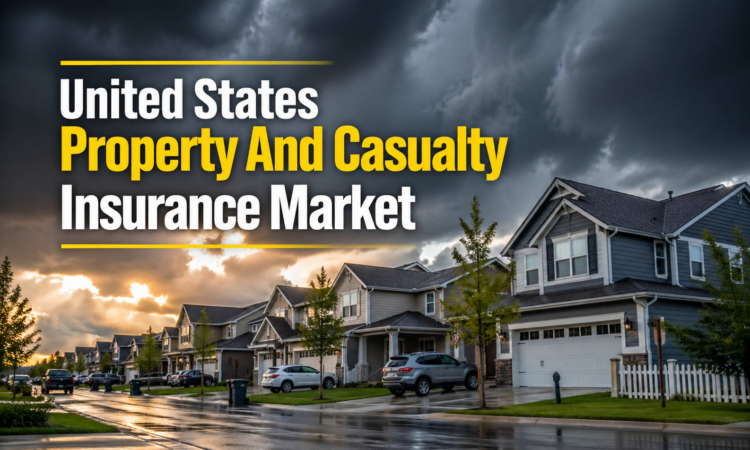
The storm didn’t knock. It arrived unannounced, rattling windows, flooding streets, and leaving behind more than just damage. For millions of Americans, moments like these turn into a single pressing question: what now? In that fragile space between loss and recovery, one industry quietly determines how fast life can be rebuilt.
Behind every repaired roof and every replaced vehicle lies a vast, evolving system. The United States property and casualty insurance market is no longer just about policies, it’s about resilience, adaptation, and the shifting realities of risk in a changing world.
A Market Defined by Stability and Subtle Transformation
The backbone of financial protection in America, the property and casualty sector has long operated with a sense of reliability. Covering everything from homes to automobiles, it reflects the everyday risks individuals and businesses face. Yet beneath its steady exterior, transformation is underway.
According to Mordor Intelligence, the United States property and casualty insurance market size in 2026 is estimated at USD 1.14 trillion, growing from 2025 value of USD 1.10 trillion with 2031 projections showing USD 1.39 trillion, growing at 3.91% CAGR over 2026-2031.
This steady climb reflects more than economic expansion—it signals a recalibration of how risk is priced and managed. The United States property and casualty insurance market growth is being shaped by climate volatility, rising repair costs, and increased claims frequency. These forces are quietly redefining underwriting strategies and premium structures.
For consumers, it often shows up as subtle changes, higher premiums, stricter coverage terms, or new policy exclusions. For insurers, it’s a balancing act between profitability and protection in an increasingly unpredictable environment.
The Human Side of Risk and Recovery
Numbers alone don’t capture the emotional weight carried by this sector. Every policy represents a story, a family safeguarding their home, a small business protecting its livelihood, a driver hoping for peace of mind on crowded highways.
The United States property and casualty insurance industry thrives on these everyday narratives. But today’s policyholders are more informed, more digital, and more demanding. They expect faster claims processing, transparent communication, and personalized coverage.
This shift is influencing the United States property and casualty insurance market share distribution among providers. Companies that invest in digital tools, AI-driven claims, mobile-first platforms, and predictive analytics, are gaining a competitive edge. Meanwhile, traditional players are racing to modernize without losing trust.
From wildfire-prone regions in California to hurricane corridors along the Gulf Coast, insurers are also rethinking geographic exposure. Some are tightening coverage, while others are innovating with new risk-sharing models. The result is a market that feels both familiar and fundamentally different.
Navigating the Future of Protection
Looking ahead, the industry’s trajectory suggests measured but meaningful expansion. The United States property and casualty insurance market size continues to grow steadily, but not without challenges. Inflation in construction materials, legal costs, and catastrophic event payouts are putting pressure on margins.
At the same time, opportunities are emerging. Usage-based insurance, parametric policies, and climate risk modeling are opening new avenues for innovation. These developments are shaping the next phase of United States property and casualty insurance market growth, where technology and data play central roles.
The United States property and casualty insurance industry is also becoming more inclusive, designing products for underserved communities and small businesses that were previously overlooked. This shift not only expands coverage but strengthens economic resilience at a broader level.
Ultimately, the market is less about reacting to disasters and more about anticipating them. It’s about turning uncertainty into structured protection, quietly enabling recovery when life takes an unexpected turn.
In a world where unpredictability is the only constant, this industry remains a silent partner in stability. But as risks evolve, so must the systems designed to manage them.
When the next unexpected moment arrives, will the safety net feel strong enough—or is the market still catching up to reality?


