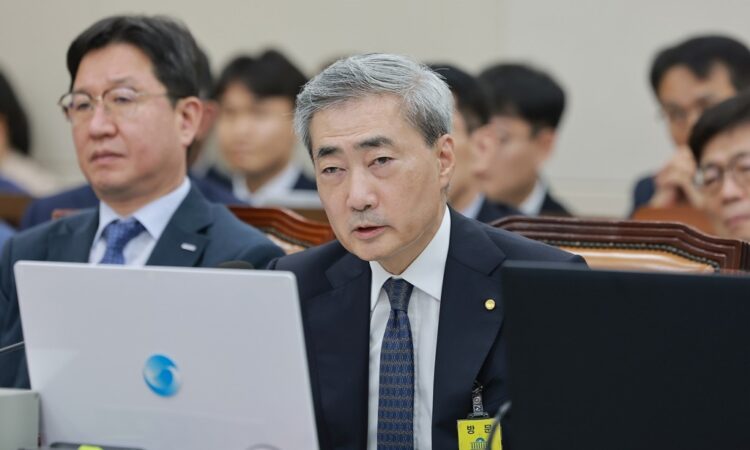
South Korean central bank chief said on Thursday the won currency is poised to rebound as a global artificial intelligence-driven semiconductor boom bolsters fundamentals of Asia’s fourth-largest economy.
Bank of Korea Governor Shin Hyun Song also reiterated that policy interest rates will need to rise at an appropriate time, given higher growth and inflation, ahead of a monetary policy meeting next week.
“I believe there is ample room for the won to strengthen going forward,” Shin told parliament, when asked about the South Korean currency’s weakness. “We are currently accumulating a very large current account surplus.”
South Korea is expected to post a current account surplus above $250 billion this year, following a record May surplus driven by chip exports, even as foreign investors sold Korean stocks at the fastest pace on record.
NO IMMEDIATE NEED TO SEEK CURRENCY SWAP WITH FED
Shin also downplayed concerns over a dollar shortage, saying the country does not need to pursue a bilateral currency swap agreement with the US Federal Reserve to save the ailing won.
While acknowledging that a Fed swap line serves as a powerful “symbolic and psychological” stabilizer for investor sentiment, Shin emphasized that its operational purpose is strictly to inject capital during a financial crisis.
“A currency swap is a mechanism that provides liquidity when liquidity has dried up, and in the current situation, liquidity is not lacking,” he stressed.
The won has lost 4.4% against the dollar so far this year as capital outflows, especially to US assets, outpaced the robust semiconductor exports of South Korea, home to the world’s two largest chipmakers – Samsung Electronics Co. and SK Hynix Inc.
Shin said the local currency remained under pressure from capital outflows from domestic financial markets and a possible Fed rate hike.
“The dollar has been firm on a potential shift in US monetary policy,” Shin said. “The domestic market also has bearish factors such as portfolio rebalancing by foreign investors.”
The won is expected to eventually reflect long-term bullish factors and rebound, however, he said.
Foreign stock selling is predicted to subside in the second half as the recent slides in South Korean stock markets are unlikely to become a trend, he added.
“While immediate supply and demand dynamics dictate (the currency market) in the short term, economic fundamentals ultimately prevail over the long run,” Shin said.
BOK NEEDS TO HIKE INTEREST RATES
The BOK needs to raise interest rates at an appropriate time as inflation is expected to remain elevated for a “considerable period,” although the US-Iran tensions eased, Shin said.
Economic growth is also accelerating thanks to strong semiconductor exports, he said. “I believe there needs to be a rate hike at an appropriate time,” Shin reiterated.
“We need to consider factors such as inflation hovering above target, improved growth and extended risks to financial stability.”
The central bank has already been expected to increase its policy interest rate at least twice to 3.0% this year, a survey of economists by The Korea Economic Daily showed in late May. Such monetary policy tightening is likely to support the won.
BOK policymakers, who have kept the benchmark policy interest rate unchanged at 2.50% since July last year, are scheduled to meet on July 16.
OPTIMISM AMONG POLICYMAKERS
Shin was not the only South Korean policymaker who expected the won to eventually rebound.
“We may soon find ourselves in a completely inverted macroeconomic layout where we are scrambling to manage an aggressive, rapid appreciation of the won rather than its depreciation,” Kim Yong-beom, chief presidential policy secretary, said at a forum co-hosted by The Korea Economic Daily on Wednesday.
Kim said the won came under short-term pressure from foreign investors’ profit-taking following a sharp rally in the shares of Samsung and SK Hynix.
The won has yet to find support as it takes time for these semiconductor giants to repatriate and convert billions of dollars in overseas earnings into the South Korean currency, he said.
STRENGTHENS PAST PSYCHOLOGICALLY IMPORTANT 1,500 LEVEL
The won on Wednesday briefly strengthened past the psychologically important 1,500 per dollar level, for the first time in nearly six weeks, on expectations of a capital influx of up to $30 billion linked to SK Hynix’s American depositary receipt (ADR) debut on the Nasdaq.
The South Korean currency appreciated to 1,498.1 versus the greenback. It was the first time for the won to strengthen past the 1,500 level since May 29.
Foreign investors turned net buyers in the South Korean stock market, ending their selling spree from June 19, supporting the won.
Top policymakers, including Deputy Prime Minister and Finance Minister Koo Yun‑cheol and Shin, also warned against excessive volatility in the currency market as the country launched its historic 24-hour onshore spot dollar-won trading system.
The SK Hynix ADR listing on Friday is expected to help the won rebound as the world’s second-largest memory chipmaker reportedly plans to sell a significant portion of the proceeds to buy the won. That anticipation triggered stop-loss dollar selling, currency market sources said.
“As expectations of a dollar influx following the ADR listing have grown, the sustained preference for the dollar has eased,” said Lee Yu-jeong, an FX analyst at Hana Bank in Seoul.
“A change in the big figure could prompt exporters, which have been accumulating dollars, to scramble for the won. That will lift the won further.”
Still, the Fed holds the key for the won’s long-term direction, economists said.
“The Fed’s monetary policy stance is the most important factor for the exchange rate,” said Park Sang-hyun, chief economist at iM Securities Co. in Seoul.
“The won is likely to head to the mid-1,400s range only when inflation stabilizes and views on US rate hikes weaken.”
Jongwoo Cheon edited this article.