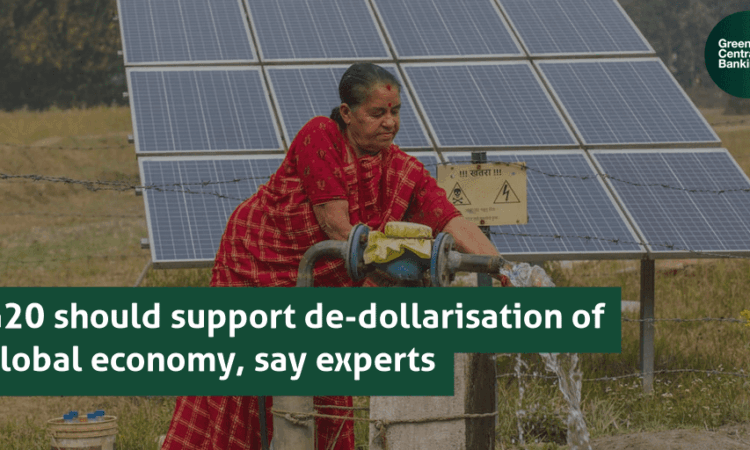

Reducing global reliance on the US dollar in favour of local currencies could lower systemic risk and increase uptake of green energy. © Nabin Baral / IWMI
G20 countries should support efforts to reduce the dominance of the dollar in the global economy and promote the use of local currencies for trade and finance to reduce systemic risk, according to a group of thinktanks.
G20 heads of state met in South Africa last week, although US president Donald Trump boycotted the meeting. Thinktanks and research institutes from G20 countries, known as the T20, met in Johannesburg ahead of the summit to discuss policy recommendations for the G20.
The T20 agreed on a communique that includes a call to reduce the dependence of the “international financial architecture” (IFA) on “one single currency”, which it said left countries in the global south exposed to external shocks and debt crises.
“The G20 should support actions aimed at diversifying the IFA by promoting the use of local currencies at the international level in trade and finance. This would help to reduce systemic risks, lower transaction costs and strengthen global financial resilience in case of crises related to one specific currency,” the communique said.
Bruno De Conti, a senior researcher at Positive Money, led the push for the topic to be included in the recommendations to the G20.
“G20 countries should build a multi-currency international architecture to reduce the asymmetries of the international monetary and financial system and reduce the consequences of the dollar hegemony, especially for the global south,” he said.
Any threat to the dominance of the US dollar as the world’s primary reserve currency is a hot topic: Trump warned earlier this year that losing the dollar’s status would be “like losing a world war”. European Central Bank president Christine Lagarde has called this Europe’s “global euro moment”.
The G20 should support a number of measures, including development of multi-currency cross-border payment systems, swap lines between diverse countries, loans from multilateral development banks in local currencies and regional arrangements for payments in local currencies, the T20 communique said.
De Conti said the idea of diversifying away from the dollar was gaining traction but it was not surprising that the US is fighting back including through the dissemination of cryptocurrencies backed by the dollar, for example in Nigeria.
“Obviously they do not want to lose the privileges of issuing the key currency of the world economy: they can have deficits in the current account for 30-40 years without any problem,” De Conti said.
The T20 called on the G20 to cooperate on the development of interoperable multi-central bank digital currencies and regional cross-border payment systems which the group said could play a key role in creating a more inclusive and resilient monetary system.
“If countries step back from the idea of developing their own central bank digital currency, it may increase the risk of further dollarisation of the world economy especially in the global south,” De Conti said.
One of the biggest problems faced by global south countries is that most of their debt is denominated in dollars, De Conti said, exposing them to a big increase in debt if the local currency suffers a depreciation.
De Conti said this dynamic was holding back countries from investing in renewable energy.
“It’s impossible to do the green transition in global south countries with the current negative consequences of the international monetary and financial system,” he said.
Last year, G20 central bankers and ministers acknowledged that currency risks and debt vulnerabilities hindered sustainable infrastructure investments in the global south.
One idea would be for debt relief to be made conditional on funds being freed up for investment in green projects, De Conti said.
This page was last updated November 24, 2025
Written by

Emma Thomasson is a British journalist, consultant and trainer based in Berlin. She is an expert in economics, politics, business and technology. She previously worked for Reuters as a correspondent and bureau chief in Germany, Switzerland, the Netherlands, South Africa and the UK.