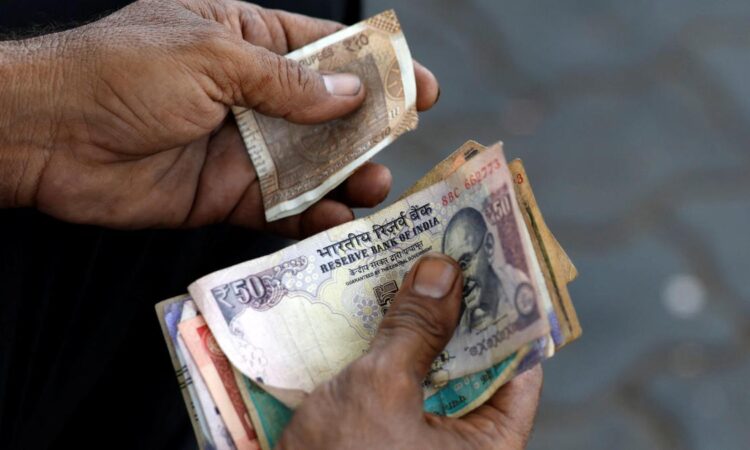
The Indian rupee has slumped to a record low against the US dollar, raising concerns regarding inflation and economic stability in India.
The Indian rupee has reached a historic low of 96.83 against the US dollar, continuing a downward trend that has persisted for nine consecutive sessions. Experts attribute this decline to several factors, including soaring global crude oil prices and capital outflows, which have severely impacted India’s economy. At the interbank foreign exchange market, the rupee opened at 96.89 before slipping further to close at 96.83, marking a 13 paise drop from its previous close. This decline follows a significant loosing streak; in the previous session, the rupee had fallen by 50 paise. Analysts indicate that the surge in US Treasury yields and a stronger dollar are contributing to inflation fears, which exacerbate the situation. Anuj Choudhary, a research analyst at Mirae Asset Sharekhan, noted, “We expect the rupee to trade with a negative bias amid inflation worries and global market risk aversion.” As a result, the Indian rupee has become one of the poorest-performing currencies in Asia this year. Rising crude prices compound the issues faced by the rupee, as India heavily relies on imports for over 85% of its energy needs. Recent turmoil in the Middle Eastern region, particularly exacerbated by the conflict involving Iran, has driven oil prices upwards. Brent crude oil prices have surged from approximately $70 to over $100 per barrel since the onset of the conflict. The government’s attempts to shield consumers from rising prices have included holding fuel rates steady during recent elections but have now begun to increase them gradually. As the inflation rate rises due to escalating oil prices, the Reserve Bank of India (RBI) faces the challenge of controlling inflation without depleting its forex reserves, which currently stand at around $697 billion. However, experts like Madan Sabnavis from the Bank of Baroda suggest that it may be prudent for the RBI to refrain from intervening aggressively in the forex market. He explained, “Allowing the rupee to reach its natural level may be beneficial, as it could foster export competitiveness.” The falling rupee also highlights broader economic concerns such as the balance of payments situation in India, notably the trade deficit and capital account shortfalls. As the debate on the rupee’s future continues, questions persist about whether it could breach the psychologically significant $100 mark. With both domestic and international factors at play, the outlook for the Indian rupee remains uncertain.