WSJ: “Success of the Korean Stock Market Ironically Spurs Selling”
Bloomberg: “Disconnect Between Stock Market and Exchange Rate Is Unusual”
Recently, there has been growing attention on analyses suggesting that foreign investors, who have been selling large amounts of stocks in the domestic equity market, are also impacting the value of the won. This year, the Korean won has shown the weakest performance among major Asian currencies.
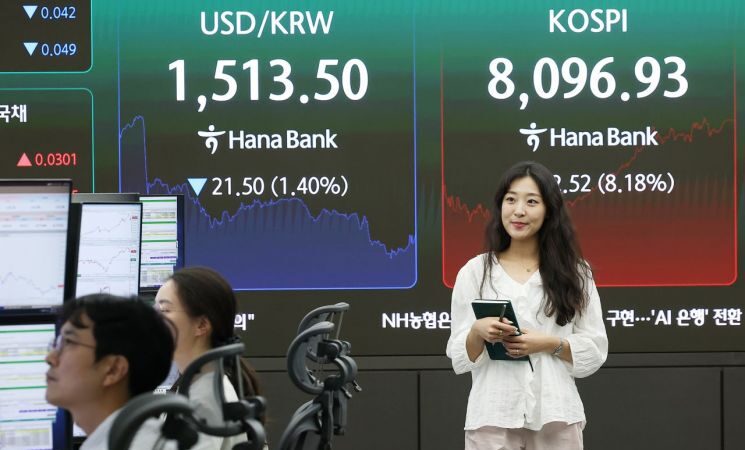
The Wall Street Journal (WSJ), a leading U.S. economic publication, reported on June 8 (local time) that the won has been the weakest among Asian currencies recently, identifying “net selling by foreigners in the Korean stock market” as a primary cause of the depreciation. Currently, the won-dollar exchange rate has surged to its highest level since 2009, meaning the value of the won has declined against the dollar.
WSJ noted that while the KOSPI surged up to 109% at one point this year, resulting in a steep rise, it has also exhibited high volatility due to a reduction in holdings by overseas asset management firms and others.

On the 9th, the won-dollar exchange rate fell compared to the previous day (indicating a rise in the won’s value), but it still remained in the 1500 won range. Photo by Yonhap News.
Typically, when stock prices rise, the exchange rate also tends to strengthen. However, in Korea, a “divergence” phenomenon—where specific prices move in opposite directions—has been observed. Bloomberg, another financial publication, also pointed out that “the disconnect between the currency and the stock market is unusual,” adding, “Ordinarily, a strong stock market should be accompanied by a strong currency.”
Why, then, has the relationship between the stock market and the currency broken down? The Bank of Korea released an analysis on this issue in April. First, the way Korea uses its trade surplus from exports has changed. In the past, export earnings were accumulated as foreign exchange reserves, but now a greater proportion is flowing out through overseas investments by households and institutions.
The stock market is also a factor behind the weak won. When foreign investors in the domestic stock market sell shares, the won is converted into dollars in the process, increasing dollar demand and further weakening the won. WSJ explained, “The success of the Korean stock market is ironically prompting foreigners to sell.”
Meanwhile, on June 8, the Financial Supervisory Service held a meeting with the Bank of Korea and representatives from major commercial banks to discuss the foreign exchange market and requested cooperation. Authorities assessed that high gains in the domestic stock market have led foreign investors to adjust their holdings and take profits, thereby increasing exchange rate volatility.
Hot Picks Today
![After-Work Side Job Planners Flock in for '130,000 Won a Month' Allowance, but Side Effects Grow [Financial Microscope]](https://cwcontent.asiae.co.kr/asiaresize/93/2024040208534725604_1712015628.png)
They also discussed the need to devise measures to absorb offshore non-deliverable forward (NDF) transactions—derivative financial products settled in dollars for the difference between the contracted and actual exchange rate at maturity—into the domestic foreign exchange market, as NDF trading overseas can drive the exchange rate in a particular direction.
This content was produced with the assistance of AI translation services.
© The Asia Business Daily(www.asiae.co.kr). All rights reserved.