Indian Students Abroad News: How a weak rupee is forcing Indian students in US, UK, Australia to skip meals, hitting grades
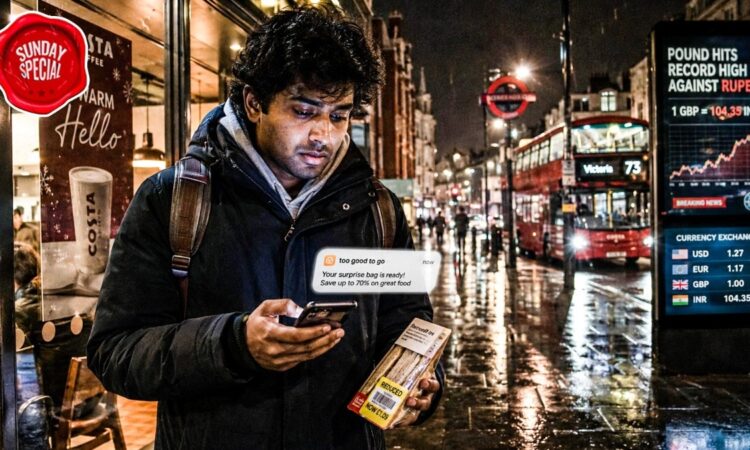
“An 8-pound sandwich in London is affordable only when it is hours away from being thrown into the bin. The ‘Too Good To Go’ app sells it for 2. 5 pounds -3 pounds. But to get near-expiry food, we students need to run to the store. Someone else could claim it if I’m not on time. That’s how I fed myself for about a quarter of a year in London,” says Manvi Koli, who returned to India in March this year, after completing her master’s degree from King’s College London. Back then, the rupee had breached the 93-mark against the US dollar. Right now, it is over 95, and can hit the 100-mark any time, say experts.
Frugality is the word of the moment right now. PM Narendra Modi has outlined several measures to save India’s valuable foreign exchange reserves. But the weakening rupee has pushed several Indian students abroad towards budgeting for basic survival. From doing odd jobs like mopping floors at department stores and railway stations on top of their official part-time shifts, to surviving on just one meal a day or even skipping meals, studying abroad amid a crashing rupee is harsher than the perception of foreign education sold. This is largely the situation unless one comes from serious privilege. As Koli said, she ran to grab the near-expiry food to survive and, of course, save the money she had been sent from India.
The reality of an Indian student’s life abroad is measured in discounts, ration handouts and carefully split grocery bills. Many choose to walk long distances instead of paying for public transport or expensive cab rides. These stretched lifestyles account for every pound and dollar (rupee too), contrary to what is romanticised.
When you are skipping meals, and constantly looking to survive, when do you study? The struggle gets reflected not just in the weight of the students, but also their grades.
Koli recalls how students, including her cousin and friends, currently studying at universities not just in the UK but also in the US, have been depending heavily on discounts offered through apps like ‘Too Good To Go’. “Food outlets like Costa Coffee and Starbucks put up food on these apps that is about to expire. The moment the listing goes live, one has to rush. That’s because if someone else books it first, it’s gone within seconds,” Manvi Koli tells India Today Digital.
“Not everyone who gets a chance to study abroad comes from an affluent background,” says Koli, who comes from a middle-class family in Maharashtra’s Thane district and studied on an education loan. “There are people on scholarships, and people whose parents have mortgaged homes to fund these degrees. The rupee factor is something I never truly accounted for while budgeting for my master’s in London, and that was a big mistake. When I left India, one US dollar was around Rs 85. By the time I returned, it had climbed to almost Rs 93,” says Koli.
The Indian rupee has now fallen to an all-time low against the US dollar and has lost more than half its value since 2009. At the time of publishing of this report, it was Rs 95.47, having crawled up from its record low of 96.87.
Just around six months ago, when the rupee slipped past the 90-mark, India Today Digital reported on how Indian students abroad were bearing the brunt of the currency slide. About just half-a-year later, the conversation around the Indian rupee has become much grimmer. It’s now affecting lives, even worse.
The factors that affected it then and those driving its depreciation now are not entirely different, but the crisis has deepened significantly within just a few months. Along with existing pressures such as a strong dollar and global capital outflows, newer shocks like the Iran war, soaring Brent crude prices and a wider global energy crisis have added fresh pressure on the Indian rupee.
TO UNDERSTAND WHY THE RUPEE IS FALLING AND WHAT ECONOMISTS HAVE TO SAY ABOUT IT, READ OUR DEEP-DIVE ARTICLE HERE
But more importantly, the Indian rupee is edging closer to the psychologically significant 100-mark, and it is affecting not just students abroad, but also the families funding their education from India. Until a few years ago, it was mostly the pound that made the rupee look visibly weak, with the rupee slipping into three digits against it in 2013. Then in 2022, the rupee touched the 100-mark against the euro.
Now, the idea of the dollar nearing Rs 100 has turned the currency slide into a psychological marker of anxiety for middle-class families already struggling to finance foreign education.
TOP-UP STUDENTS LOANS NEEDED BY FINAL SEMESTER
As most foreign universities charge fees semester-wise, a falling rupee often means the original education loan is no longer enough by the final semesters. It’s forcing their families to take additional loans to cover the remaining fees because the number of rupees that they would spend before has risen. We will explore this in detail later in this piece.
For Indian students overseas, the consequences of a failing rupee are immediate and quite personal, as their living standards change drastically. And for the parents who fund these studies, the cost of sending money abroad is even higher. They now have to spend more rupees for a dollar or a pound.
It’s the same story for students across the UK, the US, Australia and Singapore. The Indian rupee has dipped against most currencies and austerity measures by Indian students abroad have started showing up in everyday decisions.
Students don’t just stop eating outside. Nights out vanish from calendars. Forget cabs, even public transport begins to feel expensive. The students take long-distance walking, 10 km at times.
“Public transport in the UK is insanely costly. A one-way Tube ride during peak hours can cost five pounds. You think twice before taking the metro,” says Koli.
Here is how the falling rupee is reshaping students’ lives, one rupee at a time.
HOW THE FALLING RUPEE AFFECTS FOREIGN STUDENTS’ FEES, LOANS
The weakening rupee affects Indian students abroad in two ways, often simultaneously.
Tuition and living costs become more expensive in rupee terms, and at the same time, education loans taken in India also swell over time.
Students paying fees in dollars, pounds or euros suddenly find that the same amount of foreign currency requires significantly more rupees from home. Families that plan finances around a certain exchange rate later find out that the same monthly remittance buys less food, less travel and less comfort abroad.
A student at New York University (NYU), Sanjana M Kumar, spoke to India Today Digital about six months ago, when the rupee had just hit the 90-mark. She was following austerity measures already back then, like walking a few blocks before taking a cab at night, when the subway became unsafe for women’s solo commute.
Six months later, she says, “The impact of the rupee depreciating has been accumulating over the last six months. The amount my parents send has remained the same, but its purchasing power has shrunk considerably now.”
With US President Donald Trump tightening rules around immigration and work visas, many Indian students in the US are now worried not just about rising costs, but also about employment after graduation. Students say increasing uncertainty around the H-1B visa system, and the Optional Practical Training (OPT) programme have made the future even more unpredictable.
“My stress has now become layered. Earlier, it was just the money. Now, it’s also employment. If I don’t get a job in the US and have to return to India, this loan will be repaid not in dollars, but in rupees,” says Kumar, whose family is now worried about the post-study phase as well.
Kumar says many students in the US rely on university-run food distribution programmes to save money. “Many universities distribute vegetables, milk and groceries once a week, and students stock their refrigerators with those supplies to reduce expenses on eating outside,” explains Kumar.
“Students share apartments, pool groceries together and meal-prep enough to make food last for at least three days of the week. Going out, eating outside, socialising, those are the first things that get cut when the dollar gets stronger,” Kumar tells India Today Digital.
PAYING RENT QUARTERLY, TAKING UP ODD JOBS, LOSING WEIGHT
Meanwhile, Aishwarya Seth, who studied at The University of Edinburgh, says many students delay quarterly accommodation payments hoping the pound-rupee exchange rate would improve, but end up paying higher interest instead. “People get stuck waiting for the rate to fall,” she says. Seth adds that to cut costs, several students squeeze into a single room or apartment and split rent among seven or eight people.
Seth says many Indian students survive by taking up physically demanding jobs beyond their officially permitted work hours. “Students work extra cash jobs for wages far below the minimum wage just to make ends meet,” Seth tells India Today Digital.
“People do warehouse work, garbage collection for restaurants, sweeping and mopping. Many survive on one meal a day, lose weight drastically, and spend most of their time working instead of living the student life they imagined,” she adds.
Even in smaller university towns across the UK, daily life has become increasingly expensive as the pound continues to strengthen against the rupee.
Aslesha Jadhav, a student at Lancaster University, UK, says students have started cutting back on expenses like food deliveries and travel as the pound keeps getting more expensive against the rupee. “When I came to the UK, the pound was around Rs 110. Now it’s touching Rs 129 on some days, which is scary for students studying on education loans,” she says.
Jadhav says many students in the UK now depend on apps like Olio, which distributes groceries nearing expiry for free. “There were days I would have gone hungry if I didn’t have access to that app. Public transport is expensive too, so even people who hate walking end up walking long distances just to save money,” she says.
Anisha Gupta, a PhD scholar from Carnegie Mellon University, Pittsburgh, Pennsylvania, US, says the struggle of Indian students gets reflected in their grades too.
“White people are genuinely shocked when they hear students are skipping meals or cramming four or five people into one room just to save money. In Western countries, having your own room is seen as basic dignity,” says Gupta.
“What people don’t realise is that constant cost-cutting eventually affects grades too. You cannot perform academically at your best when survival itself becomes stressful,” she adds.
HIDDEN FEE HIKE THAT NO UNIVERSITY ANNOUNCES. IT’S A BURDEN ON FAMILIES IN INDIA
Unlike a formal tuition revision, currency depreciation functions like an invisible annual fee hike for Indian families.
Mumbai-based foreign education consultant Yash Mehta says most middle-class families budget only for the obvious costs before sending their children abroad. “People calculate tuition fees, rent, and to-and-fro airfare for holidays. What they don’t fully account for is how currency fluctuations increase each of these expenses,” Mehta tells India Today Digital.
“Health insurance, visa renewals, bank conversion charges, transportation, winter clothing, deposits, even everyday purchases — everything becomes more expensive when the rupee keeps weakening over a long period,” says Mehta.
He says the burden becomes especially difficult for families dependent on education loans. “These loans are taken in rupees, but the fees are paid in dollars, pounds or euros. So every time the rupee falls, families effectively end up paying more for the exact same degree,” Mehta explains.
“Since universities charge fees semester-wise, many families realise by the final semesters that the original loan amount is no longer enough because of the weaker rupee. That’s when they are forced to take top-up loans,” Mehta adds.
New York-based software engineer Abir Bhattacharjee, who studied at Arizona State University, says the impact becomes severe on long-duration courses. “Over four or five years, even a small depreciation in the rupee-dollar exchange rate can add lakhs to the total cost of education,” he says.
“A semester fee that looked manageable in the first year suddenly requires much more money from India by the final years of the course,” says Bhattacharjee. “And when degrees cost over $100,000, every rupee lost against the dollar increases repayment pressure.”
“Even if you are studying in the smaller cities of the UK, or even the US, there is this constant anxiety about making the money sent from home last longer. If you are studying in an expensive city like London like I did, it can give you very serious anxiety,” says Koli, whose parents work as teachers in Mumbai. “You become hyper-conscious about every pound you spend,” she added.
The rupee falling against the dollar is mostly discussed through the lens of oil imports, stock markets and trade deficits. But its impact is affecting lakhs of Indian students more than ever, who left their homes with a dream of a foreign degree and a decent return on investment after studying abroad.
The falling rupee now decides how often the Indian students abroad eat, and how large the education loan waiting back home will eventually become. But the hidden cost is the lower grades than the students deserve.
– Ends