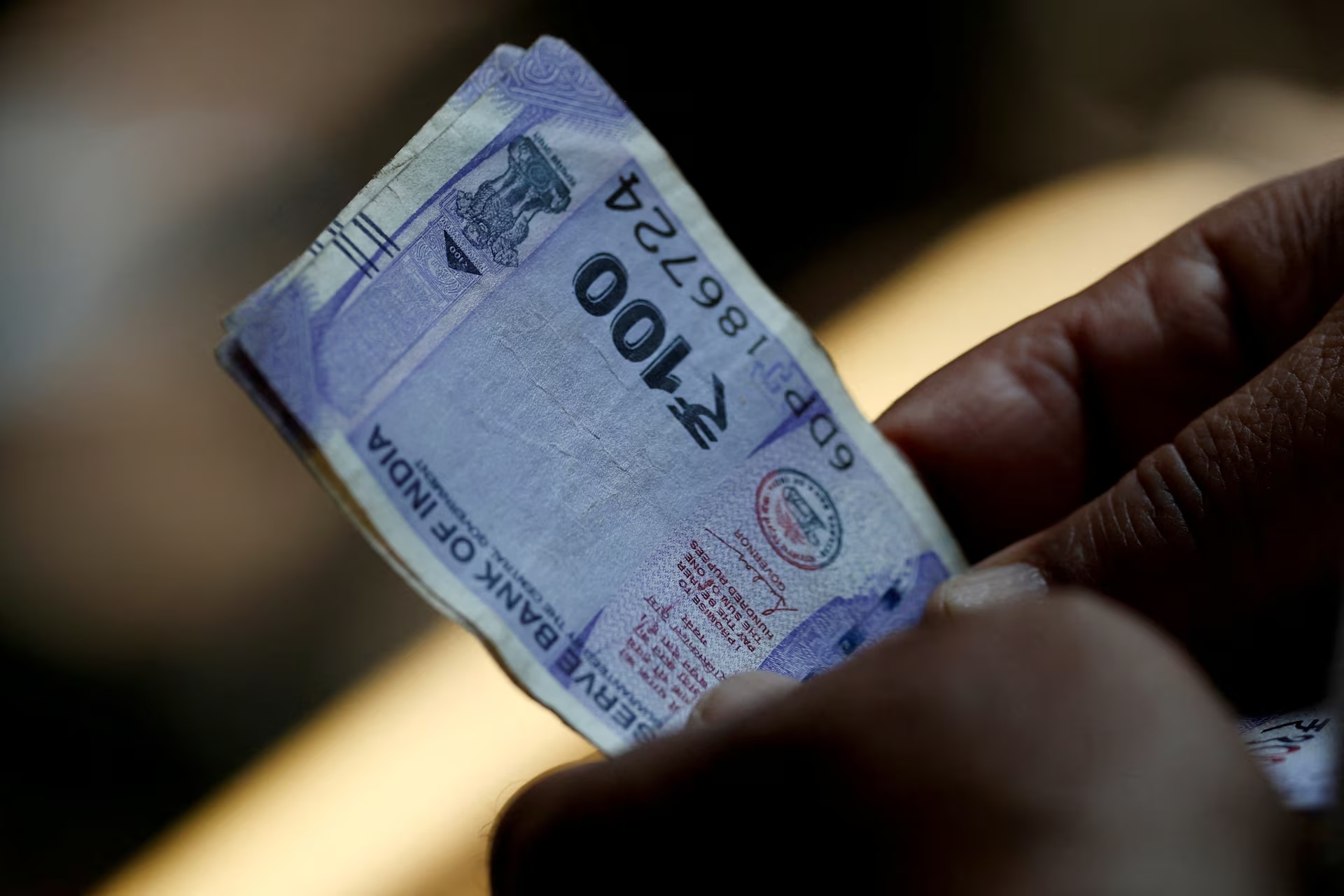
The Indian rupee strengthened modestly on Tuesday, rising 0.1% to 95.63 per dollar, as a decline in global crude oil prices and fresh policy measures to attract dollar inflows helped ease some of the intense pressure on the currency.
The move comes after the rupee hit a record low of 96.96 on May 20, having lost nearly 8% of its value year-to-date, one of the weakest performances among Asian currencies.
The latest support stems from a combination of falling oil prices, Brent crude dropped around 1% to $93.26 per barrel, and proactive steps by the Reserve Bank of India (RBI) and government to bolster foreign exchange inflows and stabilize the balance of payments.
On Monday, the RBI unveiled measures including allowing greater leverage for non-resident Indian (NRI) deposits and offering discounted currency swaps for banks’ overseas borrowings. These steps aim to draw in more stable foreign capital and build a buffer for the country’s foreign exchange reserves.
Analysts have responded positively to the policy actions. Goldman Sachs has pushed back its forecast for the rupee to reach 97 per dollar from three months to 12 months, citing reduced depreciation pressure. MUFG revised its end-September forecast to around 94 from 95.80, reflecting greater confidence in the currency’s near-term stability.
“We would be closely watching the extent of inflows under these schemes but would expect the USDINR to move towards 93 in the short run as the markets worry less about any impending BoP risks for India and the RBI builds up its FX reserve buffer,” Citi analysts noted.

The Iran War’s Heavy Toll on India’s Economy
The rupee’s recent weakness is deeply intertwined with the ongoing U.S.-Iran war, which has disrupted global energy markets and exposed India’s structural vulnerabilities as the world’s third-largest oil importer and consumer. India imports around 90% of its oil needs, making its economy particularly exposed to supply shocks and price spikes.
Since the conflict erupted on February 28, benchmark oil prices have risen sharply, at one point nearing $120 per barrel, while liquefied natural gas prices have surged 75%. The effective blockade of the Strait of Hormuz, through which roughly one-fifth of global oil and gas transits, has compounded the problem, driving up India’s oil-and-gas import bill by 53% in April compared to March.
Economists warn that the costs will continue mounting if the deadlock persists. Michael Langham, emerging markets economist at Aberdeen Investments, described the situation as “a series of supply shocks” hitting India simultaneously. Beyond oil, the war has disrupted fertilizer supplies, threatening key crops like wheat at a time when farmers are already bracing for potential drought linked to the El Niño weather pattern.

“This will all drag on India’s growth outlook, yet the ability of the RBI to look through the energy price shock from the Strait of Hormuz will be increasingly difficult given the overlapping nature of these supply shocks,” Langham said.
The central bank now projects inflation averaging 5.1% in the financial year to March 2027, up significantly from 3.48% in April, while economic growth is expected to slow to 6.6% from 7.7% the previous year. Interest rate swap markets are pricing in at least 25 basis points of rate hikes over the next three months and more than 75 basis points over the next year, limiting the RBI’s room to support growth through monetary easing.
Fiscal Strain and Policy Dilemmas
The government faces a difficult balancing act. It has delayed sharp increases in retail fuel prices, with petrol and diesel rising less than 10% since the war began, compared to 50% or more in some other Asian oil-importing countries. While this cushions consumers, it comes at a cost: the government has said it will not compensate fuel retailers for losses, potentially reducing dividends from state-owned companies and limiting fiscal firepower.
Fertilizer subsidies are projected to jump 20% in 2026/27, adding further pressure. The government has also cut gasoline and gasoil taxes, forgoing around 140 billion rupees in monthly revenues. India’s fiscal deficit target for this year is 4.3% of GDP, but a Reuters poll forecasts it could widen to 4.7%, with some economists warning it might reach 5%.
Sat Duhra, portfolio manager at Janus Henderson Investors, highlighted the broader challenges.
“India continues to face deeper structural challenges which has weighed on foreign direct investment, employment, manufacturing expansion, consumption, and nominal GDP growth. The energy shock will undermine growth and pressure government finances. Any move to rein in public-sector capex to stabilize conditions would risk further slowing growth. This leaves policymakers in a difficult position,” Duhra said.
Additional measures include curbing gold imports (a major drain on the current account), urging citizens to limit foreign travel, and promoting greater use of public transport to reduce oil demand.
The RBI’s latest actions are seen as helpful in the short term. HSBC noted that the measures could improve the balance of payments by about $30 billion in 2026-27, narrowing the projected deficit from $65 billion. In 2025-26, the BoP deficit stood at $25.2 billion, or 0.6% of GDP.
However, analysts caution that these are tactical responses to a deeper structural problem. India’s high dependence on imported energy, combined with volatile global prices and geopolitical risks, leaves the economy exposed. A prolonged war or renewed escalation in the Middle East could intensify these pressures, forcing tougher choices between inflation control, growth support, and fiscal consolidation.
For now, the rupee has found some breathing room, and policymakers have bought time. But the underlying vulnerabilities remain. Economists have noted that as long as oil prices stay elevated and the Strait of Hormuz remains contested, India’s “Goldilocks” phase of benign inflation and steady growth, once heralded by the central bank, will remain elusive.