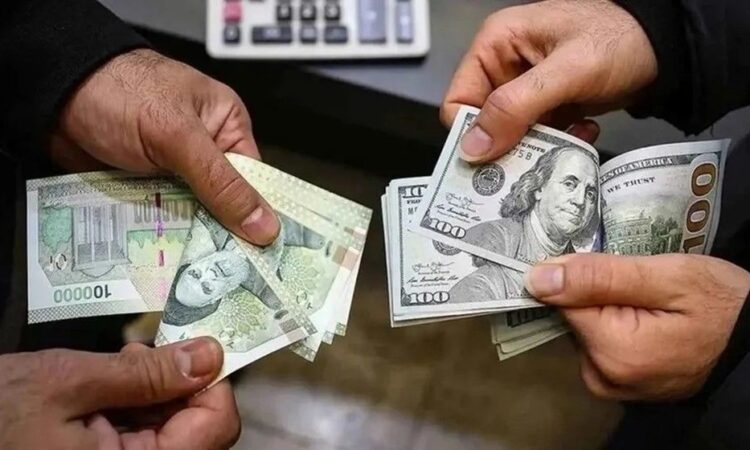
The Iranian Rial has crashed to a record low of 1.8 million rials to the U.S. dollar, according to a report by the ISNA news agency on Wednesday.
This new record low comes as the U.S. blockade continues to tighten its grip on the Iranian economy. According to Agence France-Presse (AFP), the currency reached the 1.8 million mark on the black market, as tracked by exchange rate monitoring sites Bonbast and Alan Chand. At the outbreak of the war two months ago, the exchange rate stood at 1.7 million rials to the dollar.
While Iran officially maintains multiple fixed exchange rates, these unofficial websites are widely used as the primary benchmark for the currency’s actual market value.
The International Monetary Fund (IMF) had previously projected in April that the Iranian economy would shrink by 6.1% in the fiscal year that began on March 21, with a potential rebound of 3.2% growth the following year. Prior to the war, the growth forecast for the current year was 1.1%.
Economic Fallout of the Blockade
The Strait of Hormuz has shifted from a strategic leverage point for Tehran into an economic liability. The U.S. blockade on Iranian ports, which commenced on April 13, has exacerbated the domestic crisis.
Energy experts believe the blockade is doubling the pressure on Iran’s economy, leading to a sharp decline in revenues and a severe deterioration of the national currency. While Tehran has attempted to activate land routes to bypass the maritime restrictions, experts note these measures support only limited economic activity. The crisis is expected to worsen without a total collapse in the immediate term.
On April 14, Tehran estimated its total direct and indirect economic losses at approximately $270 billion—a figure nearing the country’s total annual GDP. Government spokesperson Fatemeh Mohajerani warned that this figure remains subject to an open-ended increase.
Trade Disruptions and Costs
Iran’s economy is heavily dependent on maritime trade, with over 90% of its annual trade passing through the Strait of Hormuz. Unofficial estimates indicate that prior to the blockade, Iran exported:
Crude Oil: ~1.5 million barrels per day (approx. $139 million in revenue).
Petrochemicals: ~$54 million per day.
Minerals and Non-Oil Products: ~$79 million per day.
Imports: Settled at approximately $159 million worth of goods daily.
The Wall Street Journal revealed estimates suggesting that Washington’s blockade costs Iran more than $500 million per day. President Donald Trump confirmed this figure recently, stating it is “unsustainable even in the short term.”
Political Deadlock and Regional Tensions
On the 61st day since the outbreak of the U.S.-Israeli war on Iran, and 22 days into the current truce, the Wall Street Journal reported that President Trump has instructed aides to prepare for a “long-term blockade.” U.S. officials stated that Trump concluded the risks of resuming airstrikes or withdrawing from the conflict outweigh the risks of maintaining the blockade.
Trump recently claimed that “Iran informed us they are in a state of collapse and are demanding we reopen the Strait of Hormuz immediately.” Meanwhile, the Washington Post cited a Pakistani official stating that Tehran is offering to reopen the Strait in exchange for the lifting of the maritime blockade.
Domestically in the U.S., TIME magazine reported that Congressional Democrats are considering a lawsuit against Trump if the war continues past the legal deadline this Friday without a formal Congressional authorization.
Developments in Lebanon
In Lebanon, President Joseph Aoun and Prime Minister Nawaf Salam condemned Israeli strikes targeting Civil Defense personnel in the south. Salam described the targeting of rescue workers as a “new war crime.” Despite the temporary truce, Israel has escalated operations in southern Lebanon, with Defense Minister Israel Katz stating: “We have issued instructions to destroy all terrorist infrastructure in the security zone in southern Lebanon up to the Yellow Line.”
Source: Agencies