
Major Asian countries are facing a serious currency crash as international oil prices have soared du..
The only breakthrough is the end of the war amid the Middle East war and the screams of high inflation, with the ‘Dohwa Line’
‘Siltan’ pulled by high U.S. interest rates and even a card to raise interest rates
![A ship crossing the Strait of Hormuz [Reuters=Yonhap News]](https://wimg.mk.co.kr/news/cms/202605/25/news-p.v1.20260419.7b4fe072e4444145aae389d12dac616e_P1.png)
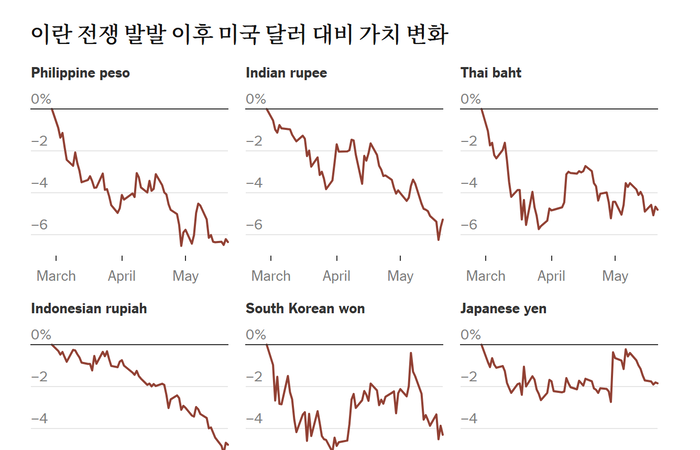
Major Asian countries are facing a serious currency crash as international oil prices have soared due to the prolonged war in Iran. While the Indian rupee and the Philippine peso have fallen to record lows, the Indonesian rupiah has weakened more than in the dark days of the 1997 Asian financial crisis.
Japan and South Korea are also pouring tens of billions of dollars into defending their currencies, but it is not enough to prevent soaring fuel costs and the outflow of funds to the U.S. dollar, a safe asset.
The New York Times (NYT) reported on the 22nd (local time) that the root cause of the sudden monetary crisis in Asia is a combination of the energy shock caused by the Middle East war and the soaring interest rates on U.S. government bonds.
As the Strait of Hormuz, a key oil and gas transit route in the Persian Gulf, is blocked, Brent crude oil prices have soared 50% since the outbreak of the war, trading around $105 a barrel. Asian countries, which are highly dependent on energy imports, have been structurally hit by having to spend more dollars to pay for oil imports.
On top of that, as the interest rate on 30-year government bonds in the U.S. bond market reached a 20-year high of 5%, a large number of investment funds staying in emerging economies are flowing out to the U.S. like low tide. This is because the so-called “Sell Asia” phenomenon of buying U.S. or Taiwanese stocks and selling Asian assets such as India, where artificial intelligence (AI) fever is blowing among foreign investors, is accelerating.

Central banks in Asia are intervening in the market by generously releasing their foreign currency reserves accumulated so far to prevent the exchange rate from plunging.
Last month alone, Japan is estimated to have spent about 63 billion dollars (about 87 trillion won) to defend the yen. Authorities try to keep the 160 yen level per dollar, but the effect of the intervention is more than half diluted in two weeks, and the yen continues to weaken.
Even as Indonesia’s rupiah exchange rate was threatened to the 18,000 rupiah-to-dollar level, the Indonesian central bank abruptly raised its key interest rate by half a percentage point, defying market forecasts. “It’s an emergency,” said Governor Perry Warzillo. We will mobilize all available means,” he said.
Since the war in Iran, foreign currency reserves in Indonesia and the Philippines have fallen by about $8 billion (down 5% to 7%) respectively, while India’s foreign currency reserves have also evaporated by about $27 billion (down 4%) as of early May.
Experts point out that this “dollar selling” intervention is only a temporary measure. Sana Urremann, a market analyst at EBC Financial Group, warned, “If central banks’ foreign exchange reserves decline faster, there will be a moment when the words ‘we have a strong reserve’ do not reassure the market.”
The decline in the value of the currency leads to an increase in import prices, which is directly hitting the economy of the common people. Low-income households in India, Indonesia and the Philippines, who spend most of their income on daily necessities, are being pushed to the brink as fuel and food prices soar. Ships are anchored at Indonesian ports, giving up their departure due to a surge in diesel prices.
As the situation became serious, Indian Prime Minister Narendra Modi directly appealed to the people at a political rally to save patriotism.
“In the current situation, saving foreign currency is a top priority. Reduce gasoline and diesel consumption and expand telecommuting. Unnecessary international travel should be cancelled and the use of gas for the kitchen should be saved.”
The Indian government is taking extreme measures to prevent the outflow of dollars, including more than doubling import tariffs on precious metals such as gold and silver.
“There is only one short-term solution for the Asian currency to rebound, and the only real end to the Middle East war,” said Alicia Garcia Herrero, chief economist for Asia Pacific at French financial firm Natixis.
Since the 1997 financial crisis, Asian countries have built up their physical strength by introducing a floating exchange rate system and increasing foreign exchange reserves, but the Middle East war has once again exposed the fundamental Achilles heel of the Asian economy’s “weak energy structure” and “dollar dependence.”


