Rupee In Freefall: How India’s Currency Slide is Quietly Making Everyday Life More Expensive
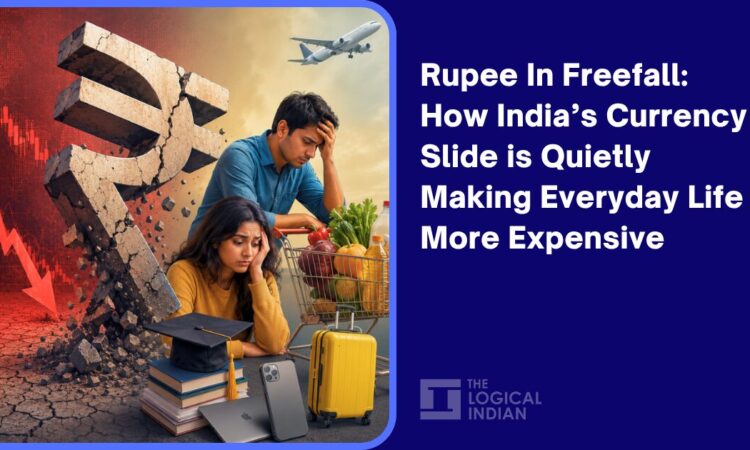
For years, many Indians viewed the rupee-dollar exchange rate as a distant market number flashing briefly on business channels. But in 2026, the falling rupee is no longer just a financial headline. It is beginning to shape everyday costs, from petrol and gadgets to foreign education and travel.
The Indian rupee has weakened nearly 11 percent against the US dollar over the past year, according to Business Standard. The currency recently touched record lows near the 95-per-dollar mark as oil prices surged, foreign investors pulled money out of Indian markets, and the US dollar strengthened globally.
The consequences are not abstract. A weakening currency quietly reduces India’s global purchasing power. Even if salaries remain unchanged in rupees, imported goods, overseas expenses, and inflation-linked costs begin rising.
Oil Prices Fuel Pressure
One of the biggest reasons behind the rupee’s decline is India’s heavy dependence on imported crude oil.
India imports more than 85 percent of its oil needs, making the economy extremely sensitive to geopolitical shocks. In recent weeks, escalating tensions linked to the Iran conflict pushed Brent crude prices above $107 per barrel, according to Reuters.
When oil prices rise, India needs significantly more US dollars to pay for imports. This increases demand for dollars inside the country and weakens the rupee further.
Reuters reported that the rupee has already fallen more than 5 percent in 2026 alone because of rising crude prices and global uncertainty.
The economic effect spreads quickly. Higher oil import costs raise transportation expenses, increase industrial input costs, and eventually push up inflation across sectors.
Foreign Money Is Leaving
Another major reason for the rupee’s weakness is sustained foreign investor outflows from Indian markets.
Global investors have been moving capital toward US assets because American interest rates remain elevated and the dollar has strengthened globally. Reuters reported that foreign investors have withdrawn more than $23 billion from Indian equities in 2026 so far.
This matters because when foreign investors sell Indian assets, they convert rupees back into dollars before exiting. That increases pressure on the currency market.
The outflows have also weighed on Indian stock markets. Reuters reported that Indian equities lost nearly $115 billion in market value during one sharp selloff linked to oil concerns and investor withdrawals.
Dollar Strength Adds Pain
The rupee’s weakness is not only about India’s domestic challenges. The US dollar itself has become significantly stronger globally.
The US Federal Reserve has kept interest rates elevated as inflation in the United States remains persistent. Higher American interest rates attract global capital into dollar-denominated assets such as US Treasury bonds.
That has strengthened the dollar against several emerging market currencies, including the rupee.
Reuters reported that markets now expect US interest rates to remain high for longer after inflation in America rose to 3.8 percent, its highest level in nearly three years.
Countries with high import dependence, especially oil-importing economies like India, tend to suffer more during periods of strong dollar appreciation.
RBI is Defending Rupee
The Reserve Bank of India has repeatedly intervened in currency markets to slow the rupee’s decline.
The central bank has sold dollars from India’s foreign exchange reserves to reduce volatility and stabilise the currency. But this defence has come at a cost.
According to RBI data reported by Business Standard, India’s forex reserves fell to around $690.69 billion in early May 2026 after sustained intervention in the currency market.
India’s reserves had earlier touched a record high of $728.49 billion in February 2026 before geopolitical tensions and oil shocks intensified.
The government has also attempted to reduce pressure on the currency by raising import duties on gold and silver from 6 percent to 15 percent. Reuters reported that policymakers hope this move will reduce non-essential imports and lower dollar demand.
Everyday Costs Start Rising
For ordinary Indians, the falling rupee eventually translates into higher costs across multiple areas of life.
Foreign education becomes significantly more expensive because tuition fees and living expenses abroad are dollar-linked. A family paying $50,000 annually for a US degree now requires substantially more rupees than a year ago.
International travel also becomes costlier. Airfares, hotel bills, visa expenses, and overseas spending all rise when the rupee weakens.
Imported electronics and gadgets are also affected. Smartphones, laptops, gaming consoles, and luxury goods often become more expensive because many components are imported or priced globally in dollars.
The impact extends beyond imported products. Since fuel prices influence transportation and logistics costs across the economy, a weaker rupee can contribute to broader inflation over time.
Reports suggest that the currency slide effectively reduces Indians’ global purchasing power, even if incomes remain unchanged in rupee terms.
Some Sectors Still Benefit
A weaker rupee is not entirely negative for every sector.
Export-oriented industries such as information technology and pharmaceuticals may benefit because they earn revenues in dollars while paying many domestic costs in rupees.
Remittances sent home by Indians working abroad also become more valuable when converted into rupees.
But for a country heavily dependent on imported energy and foreign capital, prolonged currency weakness creates larger economic stress than benefits.
The Bigger Economic Reality
The rupee’s decline reflects deeper structural vulnerabilities in India’s economy.
India remains dependent on imported crude oil, vulnerable to foreign capital movements, and exposed to global geopolitical shocks. When oil prices surge and investors pull money out simultaneously, the currency weakens rapidly.
The concern is not simply about one exchange rate level. It is about what persistent depreciation means over time. A weaker rupee slowly raises the cost of living, increases imported inflation, and reduces India’s purchasing power globally.
For millions of Indians, the currency market may appear distant. But its effects eventually show up in everyday life, often before people realise where the price increase began.
The Logical Indian’s Perspective
The falling rupee is more than a currency market story. It reflects how deeply India remains exposed to global oil prices, foreign capital flows, and external economic shocks.
While export sectors may gain temporarily, prolonged currency weakness raises costs for students, travellers, businesses, and ordinary households through imported inflation.
The focus now must remain on strengthening domestic manufacturing, reducing dependence on volatile imports, and maintaining economic stability without exhausting foreign exchange reserves or triggering sustained inflationary pressure on consumers.
Also Read: US Inflation Hits 3.8% As Iran Conflict Drives Fuel Prices And Global Energy Disruptions