Yuan’s rise signals challenge to dollar dominance as China pushes deeper global currency push – Firstpost
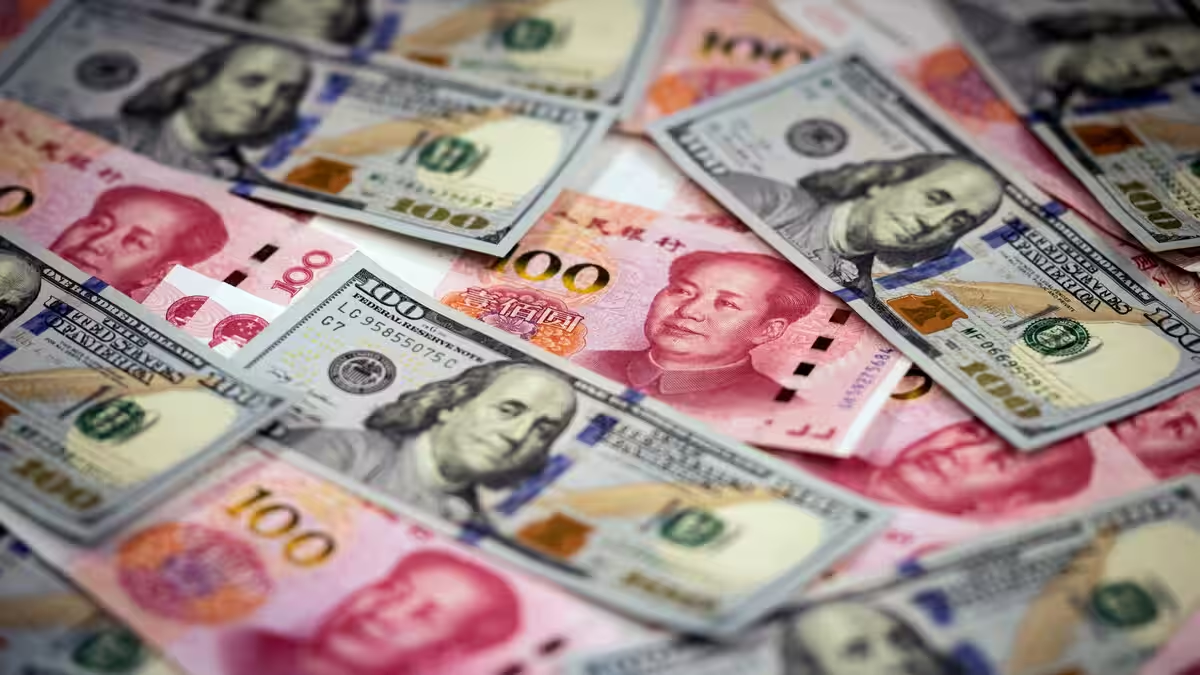
The US and China are locked in a fresh tussle over global monetary dominance as the Chinese yuan climbs to its strongest level in nearly three years. The currency’s rally has reignited debate over Beijing’s push to internationalise the yuan and challenge the US dollar’s supremacy, even as Washington moves to strengthen dollar-based financial alliances ahead of a key Trump–Xi summit
The steady rise of the Chinese yuan to a near three-year high against the US dollar is sharpening a broader debate over the future architecture of global finance, with investors and policymakers increasingly focused on Beijing’s long-term effort to expand the international role of its currency rather than any immediate currency confrontation with Washington.
The onshore yuan touched 6.79 per dollar this week, its strongest level since February 2023, ahead of a closely watched summit between US President Donald Trump and Chinese President Xi Jinping in Beijing.
While the move has revived market chatter in Washington, analysts say the shift reflects a gradual structural challenge to dollar dominance rather than a direct currency clash, driven by China’s external surpluses, trade flows and steady push to internationalise the renminbi.
The yuan has gained about 2.8 per cent this year and has outperformed several Asian peers, even as geopolitical tensions linked to West Asia developments and broader global fragmentation continue to weigh on risk sentiment.
Analysts at Goldman Sachs said the currency still appears more than 20 per cent undervalued and forecast further appreciation over the next year, citing China’s export strength and sustained current account surplus.
The bank now expects the yuan to strengthen to 6.50 per dollar within 12 months, revising earlier projections.
“The case for a stronger renminbi is more fundamental and longer-lasting,” Goldman strategists noted, pointing to China’s large trade surplus and resilient external position as structural supports.
China recorded a trade surplus of nearly $1.2 trillion last year, followed by an additional $348 billion in the first four months of 2026, reinforcing Beijing’s capacity to support its currency without heavy reliance on external financing.
The currency’s recent strength has also been supported by exporters converting large dollar earnings into yuan, according to analysts at BNY and BNP Paribas, adding another layer of underlying demand.
At the same time, expectations of more stable US-China trade engagement ahead of the Trump-Xi meeting have contributed to improved sentiment, with markets interpreting the yuan’s gains as a signal of cautious economic confidence rather than policy-driven devaluation pressures.
Beijing, for its part, has intensified efforts to expand the global use of its currency. Over the past several years, China has widened bilateral currency swap agreements with more than 40 countries, promoted yuan-denominated energy trade, and accelerated the development of cross-border payment systems designed to operate outside the traditional dollar-centric banking network.
Chinese officials have repeatedly rejected claims that Beijing actively weakens the yuan to boost exports, even as external observers, including the International Monetary Fund, have pointed to deflationary pressures that indirectly support export competitiveness.
On the other side, Washington has moved to reinforce the dollar’s global role through deeper financial alignment with allies.
According to reports, the Trump administration has been exploring expanded currency swap arrangements with partners in Asia and the Gulf as part of a broader strategy to secure dollar liquidity and reinforce the currency’s central role in global trade and finance.
US Treasury Secretary Scott Bessent has led discussions with countries including the United Arab Emirates, Japan and South Korea on mechanisms aimed at ensuring dollar access during periods of market stress.
Bessent has described these arrangements as part of America’s “economic shield”, designed to strengthen the dollar’s global position while limiting the spread of alternative payment systems linked to China.
Currency swap lines allow countries to access US dollar liquidity directly, reducing incentives to shift trade settlement toward rival currencies such as the yuan.
Economists say the expanding use of such instruments on both sides reflects a deeper structural shift: not a currency war in the traditional sense, but a slow fragmentation of the global monetary system along geopolitical lines.
Despite China’s growing financial footprint and gradual gains in yuan-based trade settlement, the US dollar continues to anchor global reserves, sovereign debt issuance and cross-border transactions.
However, the yuan’s steady appreciation and Beijing’s expanding financial infrastructure have revived concerns in some policy circles that global finance may be entering a more multipolar phase, where dollar supremacy is increasingly contested at the margins.
The upcoming Trump-Xi summit is expected to focus primarily on trade tensions, tariffs, Taiwan and developments in West Asia, but currency strategy and broader financial influence are likely to remain an undercurrent in closed-door discussions.
With inputs from agencies.
First Published:
May 13, 2026, 13:10 IST
End of Article