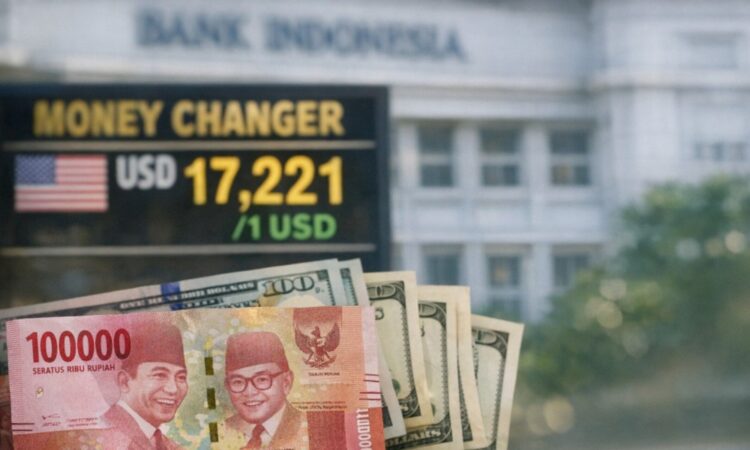
Gotrade News – The Indonesian rupiah opened 10 points lower at Rp17,221 per US dollar on Tuesday (28/04). The move tracked an oil price rally and risk-off positioning across global markets, according to Kompas.
Katadata reported the currency briefly firmed 0.14% to Rp17,218 before reversing to Rp17,235 by 09:10 WIB. The previous close on 24 April stood at Rp17,229 per US dollar.
Key Takeaways:
- Rupiah opened weaker at Rp17,221 per USD on Tuesday (28/04), per Kompas data.
- Brent crude rose 2.8% to $108.23 per barrel, pressuring emerging market currencies.
- Daily trading range projected between Rp17,150 and Rp17,300 per USD.
Lukman Leong of Doo Financial Futures said the rupiah is set to weaken as sentiment flips to risk-off. The trigger is uncertainty around Middle East peace talks after reports the US rejected Iran’s latest proposal, Lukman told Kompas.
The US Dollar Index climbed to 98.533 in early Tuesday trade. That move pulled global capital toward safer dollar-denominated assets and pressured Asian FX.
Brent crude advanced 2.8% to $108.23 per barrel, according to Kompas. The rally marked a sixth straight session of gains and added strain on energy-importing currencies like the rupiah.
Asian currencies traded mixed with Malaysia’s ringgit gaining 0.4% in the same session. The Chinese yuan and Japanese yen weakened modestly against the dollar, per Kompas data.
Bank Indonesia Governor Perry Warjiyo acknowledged sustained global uncertainty in his latest official remarks. Tariff policy and worsening geopolitical conflict were cited as the main sources of pressure on rupiah stability, RRI reported.
For global investors, rupiah weakness signals broader EM Asia FX vulnerability to oil-driven shocks. Indonesia, as a net energy importer, sits among the most exposed Asian currencies during sustained crude rallies.
Conversely, US energy producers tend to benefit when Brent and WTI rally on supply-side fears. Exposure to oil-linked US equities can serve as a natural hedge against weaker EM Asia FX.
Allocating to US dollar-denominated assets remains a relevant hedge during risk-off episodes like this one. Access to US stocks via global platforms lets investors manage FX exposure directly.
Moody’s kept Indonesia’s sovereign rating at Baa2 in February 2026, according to Metro TV. The outlook was revised from stable to negative, reflecting medium-term caution on fundamentals.
Markets will track US-Iran negotiation headlines through Tuesday’s session. A diplomatic breakthrough could ease pressure on the rupiah and revive global risk appetite.