In April 2025, a foreign exchange market survey conducted by the Bank for International Settlements (BIS), based in Basel, Switzerland, covering over 1,100 financial institutions in 52 countries and regions, revealed that the average daily trading volume in global foreign exchange markets jumped by +28% compared to 2022, reaching a record high of $9.6 trillion. Over-the-counter interest rate derivative trading has also expanded to a staggering scale of $7.9 trillion per day, an increase of +58.6%.
In parallel with this, the Society for Worldwide Interbank Financial Telecommunication (SWIFT) processes a total of approximately $150 trillion in remittance messages annually, moving an extraordinary amount of about $5 trillion per day, while the idle funds that banks around the world simply leave sitting in the accounts of partner countries (nostro/vostro accounts) as advance preparation for settlements amount to anywhere from $4 trillion to as much as $27 trillion.
Behind the scenes of such a massive torrent of money, the approximately five-year legal battle between the U.S. Securities and Exchange Commission (SEC) and Ripple finally concluded on August 8-9, 2025, with a $125 million penalty payment, and on November 22 of the same year, SWIFT completed the full transition of its international remittance message standard from the legacy MT format to the new ISO 20022 standard.
In the same month of November 2025, seven spot XRP exchange-traded funds (ETFs) were approved one after another in the United States, starting with Canary Capital’s XRPC (first-day volume of $58 million), absorbing a total of $1.68 billion in institutional investor money by mid-2026 and pulling approximately 773 million to 781 million XRP out of the market.
Furthermore, the market capitalization of the U.S. dollar-pegged stablecoin RLUSD, which Ripple issued in December 2024 with approval from the New York State Department of Financial Services (NYDFS), grew from $1.34 billion at the start of 2026 to $2.49 billion on September 28 of the same year—an 86% increase—and surpassed $2.53 billion on October 7 following the additional issuance of 30 million tokens.
Looking at the financial world now, where all these figures have erupted at once in just over a year, doesn’t it send a chill down your spine?
It looks as if a massive piece of stage machinery, prepared decades ago, has begun to rotate with a roar at the signal.
The “1988 Prophecy” and the True Identity of XRP
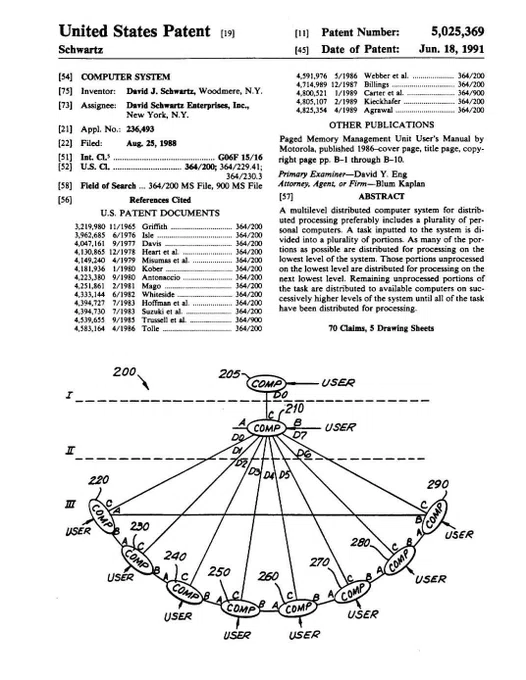
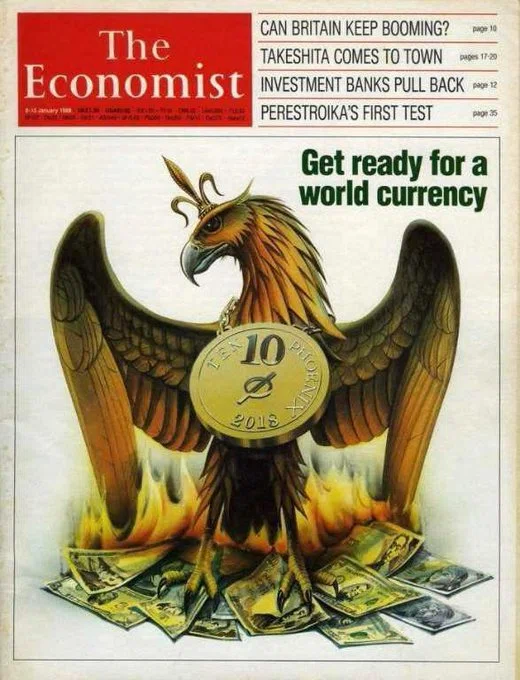
This refers to the documents for U.S. Patent No. 5,025,369, filed on August 25, 1988, and approved on June 18, 1991, and the cover of ‘The Economist’ magazine, which features a phoenix spreading its wings while wearing a gold coin around its neck inscribed with ’10 PHOENIX 2018′ atop the ashes of burning U.S. dollar bills.
This is the crypto asset ‘XRP’ associated with Ripple.
The name ‘David J. Schwartz’ of Woodmere, New York, is clearly inscribed there.
He is one of the three original developers who designed the XRP Ledger, the underlying ledger for XRP, served as Ripple’s Chief Technology Officer (CTO) from July 2018 to the end of 2025, and as of 2026, holds the position of Director and CTO Emeritus at the company—the very same David Schwartz (known online by the handle JoelKatz).
By superimposing this onto ‘The Economist’ magazine (the feature article ‘Get Ready for the Phoenix’ published in the January 9, 1988 issue, Vol. 306, pages 9-10), a myth was born: ‘A secret plan for the world unified currency Phoenix, which is XRP, already existed in 1988, and Mr. Schwartz had filed the patent for it!’
It is a romantic tale that XRP was already designed 21 years before Bitcoin was born in 2009.
A Secret Plan Held by a German Oil Company
However, the reality is that this was just a rumor with no connection whatsoever.
When you actually open and read the original text of this U.S. Patent No. 5,025,369 (Application No. 236,493), the landscape flips so dramatically that you cannot help but burst out laughing.
The patent title is just two words: “Computer system”.
Consisting of 70 claims and 5 drawings, and citing references such as the 1986 memory management unit manual published by Motorola, this document does not contain a single mention of “coins,” “ledgers,” “settlements,” or “remittances.”
The content describes only the procedure for a “multi-level distributed processing system” where large computational tasks input into the top-level parent computer (item 205 in the drawings) are broken down and sequentially distributed to multiple PCs (items 220 through 290) hanging from the second (210) to the third tier to be calculated in parallel.
In short, it is a patent for network technology that shares heavy calculations among multiple PCs.
Moreover, if you trace the registration data on Google Patents, you will find that the current owner of this patent, filed by David Schwartz Enterprises, is none other than Wintershall Dea, a German oil and gas company.
Why would a German gas company hold a top-secret program for a world unified currency? It turns out what they were digging for was not crypto assets, but natural gas in the North Sea.
The Birthday of “Zero Dollars” That Began with a Ledger Reset Halt
When the explanatory video for this “1988 XRP Birth Theory” went viral on the internet in June 2026 with over 100,000 views, former Ripple director Matt Hamilton and XRP Ledger validator Vet immediately denied it outright, stating, “This 1988 patent has nothing to do with XRP or blockchain“, and Schwartz himself stated clearly that the birth of XRP was in 2012.
In the first place, if you look back at historical records, the roots of the name Ripple lie in “RipplePay,” which was designed by Vancouver-based programmer Ryan Fugger in 2004, inspired by local exchange trading systems, and released in 2005.
This was a mechanism for settling IOUs between friends—such as “I owe you $10″—by passing them along through a network of acquaintances connected by trust; at this point, there was no sign or form of crypto asset coins.
Later, triggered by a thread titled “Bitcoin without mining” posted by Jed McCaleb on the Bitcointalk forum on May 27, 2011, McCaleb, Arthur Britto, and Schwartz began writing a consensus system from scratch to eliminate the massive power consumption of Bitcoin. During development, they initialized (reset) the test ledger thousands of times every time they updated the code, but around June 2012, because “there was no longer any programmatic reason to initialize it,” they happened to stop deleting the ledger, and that ledger is the XRP Ledger that continues to run to this day. As Schwartz himself recalls, when 100 billion XRP were generated in the first account and 80 billion of those were transferred to NewCoin (later OpenCoin, now Ripple), established in September 2012, the value of those coins was “literally zero (worthless).”
The True Scenario of “1988”
So, don’t you think it would be a waste to just close the page thinking, “Oh, it’s just a misunderstood urban legend”?
Actually, this is where it gets most interesting.
If this is not a conspiracy theory about a 40-year plan by a secret society, why do the vision of the world currency Phoenix predicted by The Economist magazine on January 9, 1988, and the distributed computer patent filed by Schwartz on August 25, 1988, appear to overlap perfectly, as if they were a single blueprint from the start, now in 2025–2026, about 40 years later?
To confirm this, let’s turn the clock back to January 9, 1988.
Why did The Economist at the time boldly predict that by 2018, thirty years later, Americans, Japanese, and Europeans would all be shopping with the same currency called the “Phoenix” instead of the dollar, yen, or West German mark?
Behind that lay the raw trauma that was shaking the global economy at the time.
It was the Plaza Accord of September 1985, the disastrous failure of the Louvre Accord of February 1987, and Black Monday (the New York stock market crash) of October 1987.
Between 1983 and 1985, the U.S. dollar surged by +34% against the currencies of major trading partners, and from there, it plummeted by -42% by early 1988.
Just four years of exchange rate volatility easily blew away the competitiveness that industries, working hard in factories, had spent a generation building.
Reading the full article from that time, one can see that the journalist who wrote it had an astonishingly calm grasp of the changes in the economic mechanism.
Since the early 1970s, the main driver of exchange rates shifted from ‘trade in goods’ to ‘cross-border movement of financial capital.’ As a result of the development of communication technology, huge amounts of money began to cross borders instantly based on slight interest rate differences. Consequently, as long as each government pursues separate economic policies for its own convenience, currency volatility will only become more intense.
Furthermore, the journalist wrote that once communication and transportation costs fall and the era arrives where ‘an Indian computer operator processes the payroll for a New York worker,’ the exchange rate risk and the hassle of remittances caused by separate national currencies will become nothing more than obstacles to business.
Given that they even predicted IT offshore development in India as early as 1988, they were not a prophet, but simply an exceptionally brilliant economic journalist.
Until the stubborn old man of the Showa era and the silent craftsman create ‘conveyor belt sushi’
On that basis, the non-conspiracy scenario depicted by ‘The Economist’ magazine was as follows: Because politicians in each country do not want to give up their right to issue currency (the privilege of covering fiscal deficits with inflation tax), they will continue to repeat currency crises, stock market crashes, and stopgap international agreements and failures even after 2018 passes.
However, no one can go against the flow of economic borders dissolving. Eventually, an international currency that the private sector can use (initially a cocktail of multiple currencies like the International Monetary Fund’s Special Drawing Rights, or SDR) will be recognized alongside existing national currencies, and people will choose a convenient world currency through ‘voting with their wallets.’ That is the plot.
However, there was one difficult problem that the economic journalist in 1988 could not solve.
In the article, it was written that ‘a new world central bank, perhaps derived from the IMF, would fix the supply of the Phoenix,’ but in the reality of international politics, there was no way the United States, China, or Europe would hand over their own purse strings to a single world central bank.
In fact, the Euro, the single European currency born in 1999 as a regional version of this concept, became a major currency accounting for 28.9% of global FX trading share in the April 2025 BIS survey (second only to the US dollar’s 89.2%, with the Japanese yen at 16.8% and the Chinese yuan at 8.5%), but it could not integrate the entire world into a single currency.
It was precisely the other piece of that puzzle—’how to maintain data consistency and establish calculation and consensus among disparate participants who do not trust each other without placing a single powerful administrator‘—that was being dug into from the side of computer science in August 1988 by an inventor who was still unknown at the time, David Schwartz.
In other words, the real scenario, which is not a conspiracy theory, is not that ‘someone planned the world currency XRP 40 years ago,’ but rather a convergence of history where two tracks that were running completely separately—’the economic necessity of the old banking network, which uses a bucket brigade for national currencies, breaking down against the explosion of cross-border capital’ and ‘the evolution of information engineering from distributed computing in 1988 to trust networks in 2004, Bitcoin in 2009, and high-speed consensus ledgers in 2012’—finally slid into the same terminal station in the late 2020s after about 40 years.
To use a familiar business analogy, it is as if a ‘stubborn old man’s fish shop’ and a ‘silent craftsman’s machinery manufacturer,’ who had separate shops in a Showa-era shopping street, were pushed by the waves of labor shortages and delivery demand in the Reiwa era and teamed up to complete a fully automatic conveyor belt sushi chain in order to survive.
There was no mastermind in 1988 planning a touch-panel conveyor belt sushi restaurant 40 years later. They were just honing their skills in different places to solve the inconveniences of the world, and the times caught up and meshed into a single system.
The 27 trillion dollar ‘pickling stone’ and the limits of the traditional international remittance network
Now, let’s take a look at the scenario in which the concept of the world currency once called the ‘Phoenix’ is being implemented in the real world of 2026, where these two tracks have merged.
Here, I will dissect with numbers just how much the current international remittance infrastructure is screaming in an outdated way.
Current international bank remittances (SWIFT and the correspondent banking network) are, so to speak, ‘a combined version of the Showa-era game of telephone and registered cash mail‘.
When sending money from one country to another, it takes 1 to 5 business days (36 to 96 hours) for the money to arrive because it goes through multiple intermediary banks, rewriting the balances of Nostro and Vostro accounts one by one.
Moreover, because fees, exchange spreads, and manual anti-money laundering verification costs are deducted at every relay point, McKinsey’s research shows that 1-3% of transaction amounts in large corporate (B2B) international transfers, over 5% for small and medium-sized enterprises, and an average of 6.2% for $200 personal remittances in 2023 (more than double the UN target of 3%, and about 7% for remittance corridors to low-income countries) are lost along the way.
Even more incredibly, to prepare for these unpredictable remittance requests, the world’s banks are locking up a total of $4 trillion to as much as $27 trillion in funds in accounts at partner banks around the world just to ‘let them sit there’.
$27 trillion. An amount that could easily cover Japan’s national budget for over 30 years with change to spare is being left to pickle as idle cash in banks around the world. What kind of expensive pickling stone is that?
The ‘Three Kingdoms of Payment Infrastructure’ Dividing the World
The non-conspiracy theory scenario currently unfolding to release this $27 trillion in dead money and turn transfers that take days into seconds is not a simple story of ‘a single world currency burning the dollar and yen to take control‘.
What is actually progressing in 2026 is a vivid multipolar scenario: a ‘hegemonic struggle between three digital payment spheres’ where national rivalries and private innovation collide, and the rise of ‘interpreters (bridge currencies)’ that connect them behind the scenes.
The first camp is the ‘direct connection of central bank digital currencies (CBDCs) and high-speed payment networks‘ of the non-Western, emerging market bloc centered on China.
Since 2022, when Russia’s invasion of Ukraine occurred, countries that witnessed financial sanctions such as the West’s exclusion of Russia from SWIFT have moved at breakneck speed toward ‘breaking away from dollar dependence‘ (due to this fragmentation between camps, trade between opposing blocs has decreased by about 12%, foreign direct investment by 20%, and the IMF estimates that global economic growth will be impaired by up to 7%).
The People’s Bank of China has expanded its digital yuan (e-CNY) pilot to over 26 cities, processing a cumulative total of over 3.4 billion transactions and 16.7 trillion yuan (approximately $2.3 trillion) by December 2025.
Furthermore, ‘Project mBridge,’ led by the central banks of China, Hong Kong, Thailand, the United Arab Emirates, and Saudi Arabia (which joined in 2024), is operating a shared blockchain ledger that exchanges CBDCs directly without passing through SWIFT or the US dollar at all.
The transaction volume of this mBridge has surged approximately 2,500-fold from 164 transactions ($22 million) during the 2022 pilot to 4,000 transactions per year totaling $55.5 billion in 2025, following the BIS withdrawal in 2024 (ostensibly due to project maturity, though concerns about avoiding US sanctions were whispered behind the scenes).
Moreover, the yuan is used as the routing currency for 95% of that total settlement amount. China’s Cross-Border Interbank Payment System (CIPS) also connects over 1,700 financial institutions in 190 countries and regions, processing over $180 billion per day, and the ratio of yuan settlements in China’s cross-border receipts and payments has jumped from 10% in 2017 to as high as 60%.
In Southeast Asia, the central banks of Singapore, Malaysia, Thailand, India, and the Philippines established the non-profit entity Nexus Global Payment (NGP) in Singapore in March 2025, and with Indonesia officially joining on February 2, 2026, they are promoting ‘Project Nexus,’ which directly connects each country’s instant payment system (IPS) using the ISO 20022 standard. Transaction volume for instant payment systems within the 11 BRICS member countries reached $10 trillion over the past 18 months, overtaking Visa and Mastercard processing volumes in major markets.
The Counterattack of the US and Megabanks, and the Shrewd Transformation of SWIFT
In response, the second camp, the coalition of the US and Western central banks and megabanks, is not just standing by and watching.
While the US prohibited the issuance of a retail CBDC by the Federal Reserve via Executive Order 14178 in January 2025, it chose a strategy to maintain the hegemony of the US dollar even in digital space (the entire stablecoin market is currently about $309.4 billion, with the top two tokens accounting for about 83%) by passing the Genius Act to popularize ‘private US dollar-backed stablecoins‘ globally.
【速報】
🇺🇸米国、ステーブルコインの新規制を正式決定
米通貨監督庁(OCC)がGENIUS法に基づく最終規則を発表。
ステーブルコインの普及に向けた制度作りが大きく前進しました。 pic.twitter.com/JvrCEWQLxQ
— Mr.₿itcoin (@coinspace_) October 21, 2026
At the same time, ‘Project Agora,’ in which the BIS and the Institute of International Finance (IIF) teamed up with seven central banks—the Federal Reserve Bank of New York, the Bank of Japan, the Bank of England, the Banque de France (under the ECB), the Swiss National Bank, the Bank of Korea, and the Bank of Mexico—and 40 private banks, conducted a real-value tokenized settlement test of 800,000 Swiss francs (about $1 million) with 28 institutions participating in July 2026, successfully achieving instant settlement in an average of 80 seconds.
Furthermore, SWIFT itself, which had been mocked by crypto supporters as an ‘outdated dinosaur,’ showed a truly clever about-face.
Having completed the transition of all cross-border payments to ISO 20022 on November 22, 2025, SWIFT announced on March 30, 2026, that it had finished the design of its own blockchain shared ledger based on the Ethereum-compatible Hyperledger Besu, entered the MVP (Minimum Viable Product) phase, and would launch a system to settle ‘tokenized commercial bank deposits‘ 24/7/365 with over 40 banks within 2026.
To ensure they never let go of their turf—the 11,000+ financial institutions that control 75-80% of institutional investor flows—they swallowed the blockchain mechanism whole and coolly declared, ‘Our new ledger can settle with bank deposit tokens without using anything like XRP’.
The tenacity of massive vested interests fighting for survival is truly formidable.
The true role played by “XRP” in the gaps of a multipolarizing digital currency landscape
Now, in this realistic scenario where separate “islands” of digital payments are proliferating—such as China-led mBridge, Southeast Asia’s Nexus, US dollar-denominated stablecoins, and the ledger of SWIFT and megabank deposit tokens—it is interesting to see how the third player, Ripple and XRP, will move.
To put it bluntly, the more separate islands proliferate and become fragmented, the more demand will arise behind the scenes for a “neutral bridge asset (buffer)” that belongs to no government and can mediate between different currencies and tokens in just a few seconds; this is the realistic survival scenario for XRP in a non-conspiracy theory context.
For example, partner companies like SBI Remit in Japan have introduced ODL (On-Demand Liquidity), which uses XRP as a bridge currency, to slash remittance costs that previously took 3-7% down to about 0.15%, and reduced settlement times from 36-96 hours to just a few seconds (93% of international settlements using XRP take less than 10 seconds).
This allows banks to reduce the required amount in their pre-funded accounts (nostro accounts) by about 65%, which is why about 45% of major remittance providers in the Asia-Pacific region have already adopted blockchain payment rails for corridors such as Japan-Philippines and UAE-Philippines.
Even more surprisingly, of the retail payment frameworks for over 50 banks that SWIFT will launch in more than 25 corridors starting in mid-2026, at least 30 banks are connected to Ripple’s ecosystem, and about 40% of them use ODL.
Furthermore, with the international payment network Thunes extending stablecoin payments to all 11,500 banks connected to SWIFT, a bypass has also been opened that allows for settlement using Ripple’s ODL rails and XRP as an underlying optional route.
Even if the bank’s storefront remains SWIFT, XRP and stablecoins are quietly flowing through parts of the back-end plumbing—a very shrewd division of labor.
The gap between ideals and reality
However, if you get carried away and think “XRP will conquer the world,” you will be caught off guard. Let’s present some cold, hard data here as well.
Extreme bulls on the internet present back-of-the-envelope calculations: “If the circulating XRP is limited to 10 billion and the daily turnover is restricted to 3 times for compliance reasons, then to process $500 billion a day (the scale of mBridge), 1 XRP would be $16,667; if it were $750 billion a day, which is 10% of the global FX market, it would be $25,000; and if it were $10 trillion a day including tokenized assets, it would be $333,333.”
Dreaming is free, but what is the reality?
Although Ripple’s cumulative payment processing volume has exceeded $95 billion to $100 billion and its annual ODL processing volume has grown to over $15 billion, it still accounts for less than 1% of the total global annual cross-border payment volume of $130 trillion to $150 trillion.
Furthermore, of the more than 300 financial institutions participating in Ripple’s network, about 60% avoid using XRP due to price volatility risks, opting instead to use only the messaging functionality or fiat/stablecoin settlements.
That is precisely why Ripple itself, armed with over 75 regulatory licenses, is using the acquisition of Standard Custody & Trust (completed on June 11, 2024) as a foothold to move toward applying for a national trust bank charter with the US Office of the Comptroller of the Currency (OCC) and obtaining a Federal Reserve master account in July 2025. Furthermore, through the acquired former Hidden Road (now Ripple Prime), it is connecting with the NSCC, a subsidiary of the US Depository Trust & Clearing Corporation (DTCC), to participate in a pilot for clearing tokenized securities that will run from July to October 2026, aiming to transform into a “regulated banking and securities infrastructure company“.
SBIホールディングスはXRPを保有しているだけではありません。
詳しく見てみると、より広範なXRP Ledgerエコシステム全体におけるポジショニングに気づくでしょう。
インフラへのエクスポージャー。
アイデンティティレイヤーへのエクスポージャー。…— Yuto 🇯🇵 (@yutokanzakireal) February 15, 2026
As a trump card, its proprietary stablecoin RLUSD was introduced and has rapidly grown to over $4 billion in monthly trading volume and a market capitalization of $2.53 billion, while tokenized real-world assets (RWA) on the XRP Ledger have also surged from about $24 million in early 2025 to about $408 million, including about $282 million in US Treasuries.
However, ironically, 56% of the issuance of that RLUSD exists on the competitor Ethereum, with only 44% on the native XRP Ledger.
Moreover, the more convenient RLUSD becomes, the more it faces the dilemma of “cannibalization of its own products,” where banks can settle directly using only RLUSD without bothering to go through XRP.
The burning of XRP through transaction fees also remains at an error-level of about 0.014% of the 100 billion total supply, totaling about 14 million as of June 2025, while the monthly unlock of 1 billion XRP from escrow continues, causing the circulating supply to keep increasing from 59.18 billion XRP in July 2025 to 63.13 billion XRP in October 2026.
As a result, XRP, which peaked at $3.42 ($3.55 on some exchanges) with a market capitalization of $202.3 billion (approximately 5% of the crypto market share, ranking 3rd) on July 18, 2025, adjusted to less than half its value by mid-October 2026, hovering around $1.34–$1.39 with a market cap of approximately $84.6 billion (about 3% market share, falling to 5th place behind Tether and BNB).
Even Goldman Sachs, after delighting retail investors by holding $153.8 million in XRP ETFs at the end of 2025, performed a remarkably shrewd round-trip trade: selling everything to zero by the end of the first quarter of 2026, only to buy back $86.5 million worth in the second quarter when prices were lower.
There is not a millimeter of romance or faith in the wolves of Wall Street.
The Phoenix as an ‘Invisible Translator’
When you connect all these facts, the true story that has been unfolding since 1988 becomes clearly visible.
While Standard Chartered analysts estimate a calm target price of $2.80 for XRP in 2026, and Ripple CEO Brad Garlinghouse sets a bold goal that ‘XRP will handle 14% of SWIFT’s liquidity (approximately $21 trillion annually) by 2030‘, the reason analysts predict an immediate market share of only 2–3% of SWIFT’s volume is quite clear.
The ‘future about 40 years later’ that The Economist depicted on January 9, 1988, and for which David Schwartz sought the foundation through his patent on distributed processing on August 25 of the same year, was not a dystopia where a single phoenix coin burns away all the world’s fiat currencies.
It was the arrival of a transparent protocol society in a multipolar world crowded with China’s mBridge, Southeast Asia’s Nexus, Western CBDCs and bank deposit tokens, and private stablecoins like RLUSD, where bridge assets like XRP act as behind-the-scenes lubricant, racing across the common language of ISO 20022 and distributed ledgers in under 10 seconds, allowing humans to shop and send money without even being conscious of ‘what currency I just used to pay‘.
When you stop searching for codes hidden in old patent dates or magazine covers and stop letting chart movements dictate your emotions, you will realize that behind the screen you use to pay with your smartphone every day, the ‘internet of borderless money’ that an economic journalist and a young engineer dreamed of separately 40 years ago is already quietly in operation.
References
-
OTC foreign exchange turnover in April 2025 – the BIS, https://www.bis.org/publications/202509-commentary-otc-derivatives
-
Triennial Central Bank Survey – OTC foreign exchange turnover in, https://media.axiglobal.net/media/mig_8183834465164af4_rpfx25_fx_8145ab6aab.pdf
-
BIS publishes results of global survey on FX and interest rate, https://www.bcentral.cl/documents/33528/6833519/Resultados+encuesta+global+BIS+english.pdf/1123dfd6-b301-4942-4258-c81686caad85?t=1762534574157
-
Global FX trading hits $9.6 trillion per day in April 2025 and OTC, https://www.bis.org/media-releases/20250930-global-fx-trading-hits-96-trillion-day-april-2025-and-otc-interest-rate-derivatives-surge-79
-
Reshaping the Global IRD Landscape: Key Findings from the 2025, https://www.isda.org/a/dBRgE/Reshaping-the-
-
Now money really never sleeps – Capgemini, https://www.capgemini.com/wp-content/uploads/2026/04/WPR_2027.pdf
-
Why SWIFT’s Blockchain Push Is a Win for Ripple but Not Yet for XRP, https://www.ccn.com/news/crypto/swift-blockchain-validates-ripple-vision-xrp-impact/
-
XRP and the Tokenised Global Financial System: A Strategic, https://medium.com/@NobodySomewhere/xrp-and-the-tokenised-global-financial-system-a-strategic-integration-framework-943d4746560b
-
Cross-Border Payments System Design Guide | Formance, https://www.formance.com/blog/embedded-finance/cross-border-payments-guide
-
XRP in 2026: ETF Flows, RLUSD Growth & What Comes Next, https://laikalabs.ai/market-intelligence/xrp-etf-rlusd-2026
-
When Will XRP Price Stage a Comeback? Here Is What to Look For, https://coinmarketcap.com/academy/article/can-xrp-make-a-real-comeback
-
XRP ETFs Hit $170M With Goldman Sachs Leads the Charge, https://memeburn.com/xrp-etf-goldman-sachs-institutional/
-
RLUSD market cap reaches $2.49B, surpassing 86% growth since, https://www.kucoin.com/news/flash/rlusd-market-cap-hits-2-49b-surpasses-86-growth-since-start-of-2026
-
Ripple mints 30 million RLUSD, expanding its st… – Pluang, https://pluang.com/en/news-feed/ripple-treasury-mencetak-30-juta-rlusd
-
XRP Crypto News: 1988 U.S. Patent by Ripple CTO David Schwartz, https://www.binance.com/en/square/post/28611212852674
-
How Old Is XRP? Testing the 1988, 2004 and 2012 Origin Stories, https://www.bullrunners.com/blog/how-old-is-xrp-1988-patent-myth/
-
David Schwartz’s 1988 Patent Has Nothing to Do With XRP, Former, https://cryptonews.net/news/altcoins/33067761/
-
The-Economist-GET-READY-FOR-A-WORLD-CURRENCY.pdf, https://www.cbcg.org/images/books/The-Economist-GET-READY-FOR-A-WORLD-CURRENCY.pdf
-
Patents Assigned to David Schwartz Enterprises, Inc., https://patents.justia.com/assignee/david-schwartz-enterprises-inc
-
David Schwartz: XRP Ledger architect and Ripple board member, https://bitcoinwiki.org/wiki/David_Schwartz
-
The Economist: “Get Ready For A World Currency By 2018”, https://goldbroker.com/news/the-economist-get-ready-for-a-world-currency-by-2018-1179
-
David Schwartz Is Satoshi Nakamoto? : r/XRP – Reddit, https://www.reddit.com/r/XRP/comments/ben6vu/david_schwartz_is_satoshi_nakamoto/
-
The man who built XRP and sold too soon – YouTube, https://www.youtube.com/watch?v=4tUxUnH3WdU
-
The international role of the euro, June 2026 – European Central Bank, https://www.ecb.europa.eu/press/other-publications/ire/html/ecb.ire202606.en.html
-
American Blockchain & Distributed Systems Museum, https://americanblockchainmuseum.org/
-
Cross-Border Payments 2026: Trends, Technology & Due, https://www.opendue.com/blog/understanding-cross-border-payments-trends-and-technology
-
COMPETING CROSS-BORDER PAYMENT NETWORKS, https://www.policycenter.ma/sites/default/files/2026-09/PB_52-26_Hung%20Tran_final.pdf
-
CBDC Updates 2026: What Changed This Year | Support – Eco, https://eco.com/support/en/articles/15210561-cbdc-updates-2026-what-changed-this-year
-
XRP price prediction: What could actually drive it in 2026 – Nexo, https://nexo.com/blog/xrp-price-prediction
-
XRP Market Share Trends – Bitcoin Foundation, https://bitcoinfoundation.org/news/altcoins/xrp-market-share-trends-why-ripples-token-is-losing-ground-in-2026/