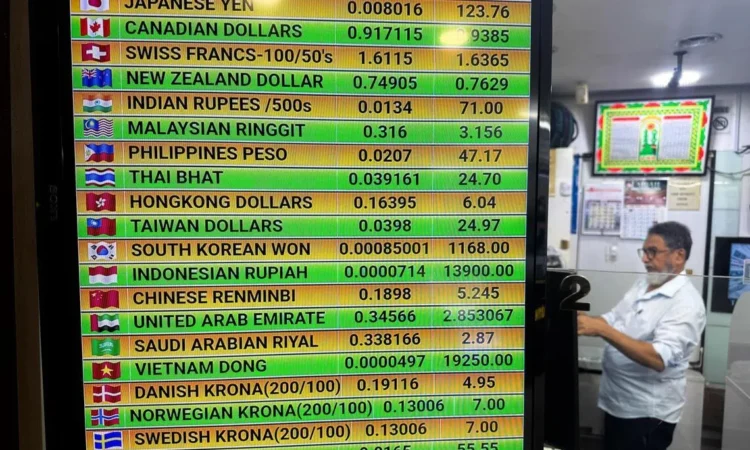
SINGAPORE – A handful of regional currencies has weakened against the Singapore dollar in 2026 amid geopolitical uncertainty and shifting investor sentiment.
The Singdollar has remained firm after the Monetary Authority of Singapore tightened monetary policy in April by allowing the currency to appreciate more quickly against a basket of other currencies.
Chow Thu Ha, head of fixed income Asia and Singapore country head at Robeco, added that the Singdollar’s strength is also due to the Republic’s relatively resilient economy, strong trade and financial position, and its reputation as a safe-haven destination during periods of market volatility.
As a result, the Singapore dollar’s purchasing power has grown in several regional markets.
Here are five Asian currencies that have lost ground against the Singdollar this year:
The Indonesian currency has weakened sharply against the Singdollar in 2026. On top of the Singdollar’s strength, the rupiah is also weighed down by a weakening trade balance and higher capital outflows.
The rupiah fell 9.2 per cent against the Singapore dollar in 2025 and has weakened a further 8 per cent in 2026, according to Bloomberg data.
On June 3, it crossed the 14,000 mark against the Singdollar for the first time before recovering some ground. It was trading at around 13,920.81 per Singdollar on June 12.
Indonesia produces oil but remains a net importer, so higher energy prices amid the fallout from the Iran war have raised import costs. This has weakened the archipelago nation’s external trade balance and fiscal position, putting pressure on the local currency.

Foreign investors have also been pulling funds from Indonesia’s bond and stock markets, and moving capital into safer assets, adding to pressure on the rupiah.
A weaker rupiah would give Singaporeans more bang for their buck in Indonesia, although some locals expect rising domestic prices to also impact tourist spending.
I Komang Kusuma, a tourist driver in Bali, said fuel prices have risen by about 3,200 rupiah (23 cents) per litre, and he expects other items to become more expensive as well.
“A weaker rupiah can be good for business if it brings in more foreign tourists like those from Singapore… But it also depends on whether they are willing to spend,” said the 52-year-old.
“Even though Indonesia is affordable, some tourists can still be cautious with their spending.”
Analysts expect the rupiah to remain under pressure for some time to come.
CMC Markets sales trader Alex Ho said even though the central bank has taken steps, such as through an emergency interest rate hike on June 10 to shore up the rupiah, this runs counter to government efforts to support the Indonesian economy.
While higher interest rates encourage foreign investors to keep their money in Indonesia, they also curb local spending and borrowing at a time when the government is proposing a larger fiscal budget and fuel subsidies to boost the economy.
That combination has led investors to flee the country anyway, as concerns mount over fiscal discipline, policy consistency and institutional credibility, Ho noted.
“Only cheaper oil or a reopening of the Straits of Hormuz would reverse the economic losses. Beyond that, the macro mix is making weakness harder to arrest,” he said.
The Philippine peso has also come under pressure against the Singapore currency this year, with implications for Singapore’s large Filipino workforce.
Like Indonesia, the Philippines is a net importer of fuel and has seen its trade deficit widen as more foreign currency is used to import oil.
The peso was trading at around 47.17 per Singapore dollar on June 12. It fell 7.45 per cent against the Singdollar in 2025 and has declined a further 4 per cent in 2026, according to Bloomberg data.
Sharon Nicolas, 46, director of Shaey Beauty Salon in Lucky Plaza, said the weaker peso means every Singapore dollar she sends to the Philippines goes further.
“When I first started working in Singapore in 2006, $1 was worth only about 30 pesos. As overseas Filipino workers, we were already happy with that rate,” she said.
“Now, $1 is worth around 48 pesos, which means we get more pesos when we send money home.”

The catch, however, is that both Singaporeans visiting the Philippines and Filipinos back home may not feel the full benefit as rising prices have eroded some of the gains, Nicolas said.
“The peso has weakened, but the cost of living keeps rising. Petrol, public transport, rice, food and other daily necessities have all become much more expensive,” she said.
CMC’s Ho said the Philippine peso remains vulnerable because the country runs a persistent current account deficit and relies heavily on imported oil.
He added that the Philippines’ central bank has limited room to support the currency after cutting interest rates by two percentage points in December 2025, as it leaves policymakers with less scope to raise rates to defend the peso without risking slower economic growth.
Those planning a trip to Thailand may find their Singapore dollars continuing to stretch further, as analysts expect the Thai baht to remain weak amid ongoing geopolitical tensions in the Middle East.
The Thai baht gained 1.86 per cent against the Singdollar in 2025 but has weakened around 4 per cent in 2026, according to Bloomberg data.
It was trading at around 25.47 baht per Singdollar on June 11.
Besides Singapore travellers, some businesses here have also benefited from the Singdollar’s strength versus the Thai baht.

Jerry Ng, managing director at Tong Seng Produce – the company best known for the SongHe fragrant rice brand – said a weaker Thai currency generally benefits Singapore importers, as Thai rice becomes more competitively priced in Singapore dollar terms.
“Thailand remains one of the world’s major rice exporters. This can help moderate import costs and support price stability for consumers,” he said.
Still, adverse weather conditions and geopolitical tensions leading to higher freight and fertiliser costs have impacted rice production globally.
“As a result, while a weaker Thai baht may provide some relief on import costs, it may not fully offset the broader upward pressures within the global rice supply chain,” Ng added.
MUFG Bank foreign-exchange strategist Lloyd Chan said the Thai baht is particularly vulnerable to a prolonged conflict in the Middle East.
Thailand is one of the region’s largest net importers of oil and gas relative to its size and economy, leaving it exposed to higher energy prices, he said.
At the same time, Thailand’s relatively low interest rates make the baht less attractive to investors, giving them less incentive to keep capital in baht-denominated assets.
“This combination of higher energy costs and weaker investor demand leaves the baht especially exposed to further downside pressure, particularly if tensions in the Middle East escalate further,” said Chan.
The South Korean currency has weakened against the Singdollar over the past year amid uncertainty surrounding trade negotiations with the United States and continued equity outflows by foreign investors.
Higher energy prices linked to the Iran conflict have added to the pressure, as South Korea is heavily reliant on imported energy.
The won fell 3.77 per cent against the Singapore dollar in 2025 and has weakened a further 5 per cent in 2026, according to Bloomberg data. It was trading at around 1,182.25 won per Singapore dollar on June 12.

Tansy Richards, a Singapore-based digital marketing manager, said she plans to spend longer periods in South Korea as the stronger Singapore dollar stretches her spending power there.
“I was already planning to go, as I head back to Korea every one to two years, but I can extend my trips now,” said the 28-year-old.
“I can definitely say yes to more things in Korea now, such as eating at pricier cafes and restaurants.”
Saxo chief investment strategist Charu Chanana said that the won is closely linked to the global technology and artificial intelligence cycle.
When optimism around AI is strong and export momentum improves, the won tends to benefit.
But it can weaken sharply when the AI cycle becomes more volatile, as it tends to be more sensitive than most other currencies to swings in the global economy.
“The won’s outlook is not just about South Korea – it is also about semiconductors, global equity risk appetite and the US dollar,” said Chanana.
The Japanese yen has also weakened against the Singapore dollar, making Japan a more affordable destination and attracting a growing number of Singaporean travellers.
The yen was trading at around 124.72 per Singapore dollar on June 12. It fell 5.59 per cent against the Singdollar in 2025 and has declined a further 2 per cent in 2026, Bloomberg data showed.

Brandon Lau, an investment analyst who travels to Japan about twice a year, said there is “no better time” to visit Japan as the yen remains near its weakest levels in years.
“I’ve already planned my next Japan trip before the new tax refund system kicks in in November,” said the 29-year-old.
Saxo’s Chanana said the yen has remained under pressure because interest rates in the United States are significantly higher than in Japan, where the central bank has been raising rates only gradually.
As long as US interest rates remain elevated and the Federal Reserve is not clearly moving towards rate cuts, the yen is likely to struggle to stage a sustained recovery, she said.
“For the yen to strengthen more durably, markets probably need to see either a softer US inflation path, lower US yields, or a more confident Bank of Japan tightening cycle,” Chanana added.