
Quick Summary
- Corporate insiders are flashing a warning sign. Executives and directors are selling far more company stock than they are buying, with insider-buying activity near its lowest level in decades.
- The market’s leadership is sending mixed signals. Insider activity looks cautious. However, industrial and transportation stocks remain strong, suggesting the AI investment boom is spreading into other parts of the economy. The bull market still appears intact, but many stocks are expensive and leave little room for disappointment.
- Economic growth is healthier than the headline GDP number suggests, but inflation remains too high. Second-quarter GDP slowed, partly because businesses imported AI equipment and reduced inventories. Underlying private-sector demand was much stronger. At the same time, inflation remains well above the Federal Reserve’s two percent target, increasing the possibility of another interest rate hike.
- One Fed rate hike could become a longer campaign. Historically, when the Fed begins raising rates, it rarely stops after one increase. Additional hikes would pressure highly valued growth stocks, increase borrowing and refinancing costs, and create more market volatility.
The people who know their companies best are selling their stocks. That should serve as a warning. But just how dire is the situation?
When it comes to a company’s future, I trust that the chief executive, chief financial officer, and directors know the most about the companies they work for. What they say in public and in earnings calls is important, but what they do more quietly can matter more. Their actions are a caution sign.
In July 2026, corporate insiders sold much more stock than they bought. University of Michigan finance professor Nejat Seyhun tracks the percentage of companies with more insider buying than selling on the Insider Sentiment website. By late July, this number was 14.8 percent, per the chart below from a Mark Hulbert article on the subject.
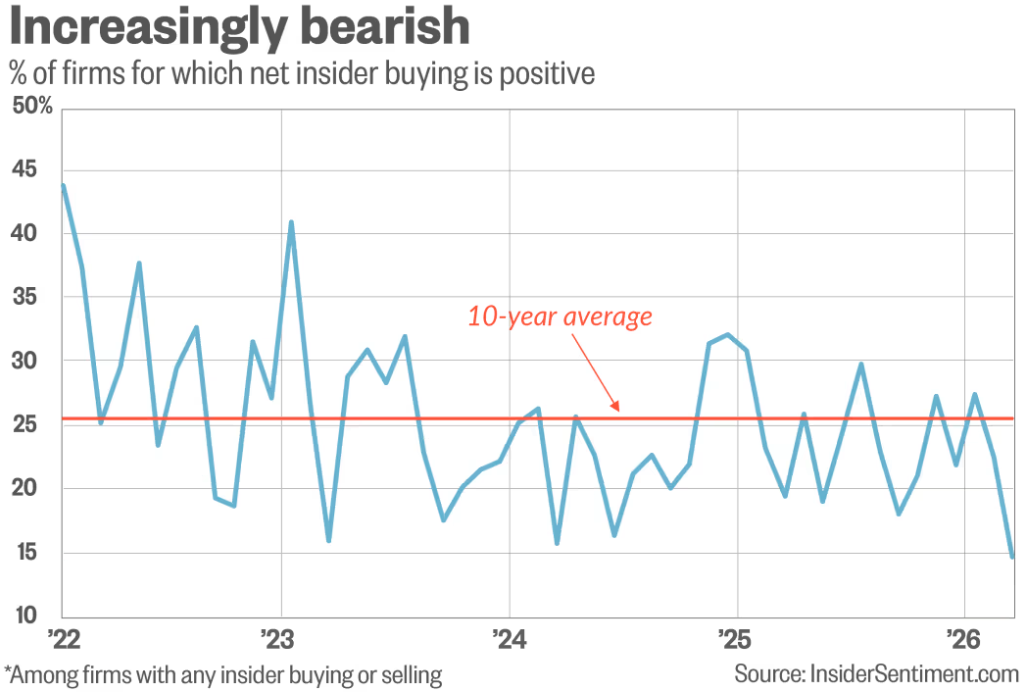
That would be the lowest level of buying versus selling in at least 21 years. For large companies with insider activity, only 3.2 percent had more buying than selling. This level of caution is unusual. It shows that some of the most informed people in the business believe current stock prices are good for selling, but not good enough for buying.
In other words, the presumption is that corporate insiders don’t feel that their stocks are a good deal now. Looking at it the other way, when insiders perceive their stocks are trading at a good price, they will buy. Consider what insiders did during the COVID-19 selloff in 2020.
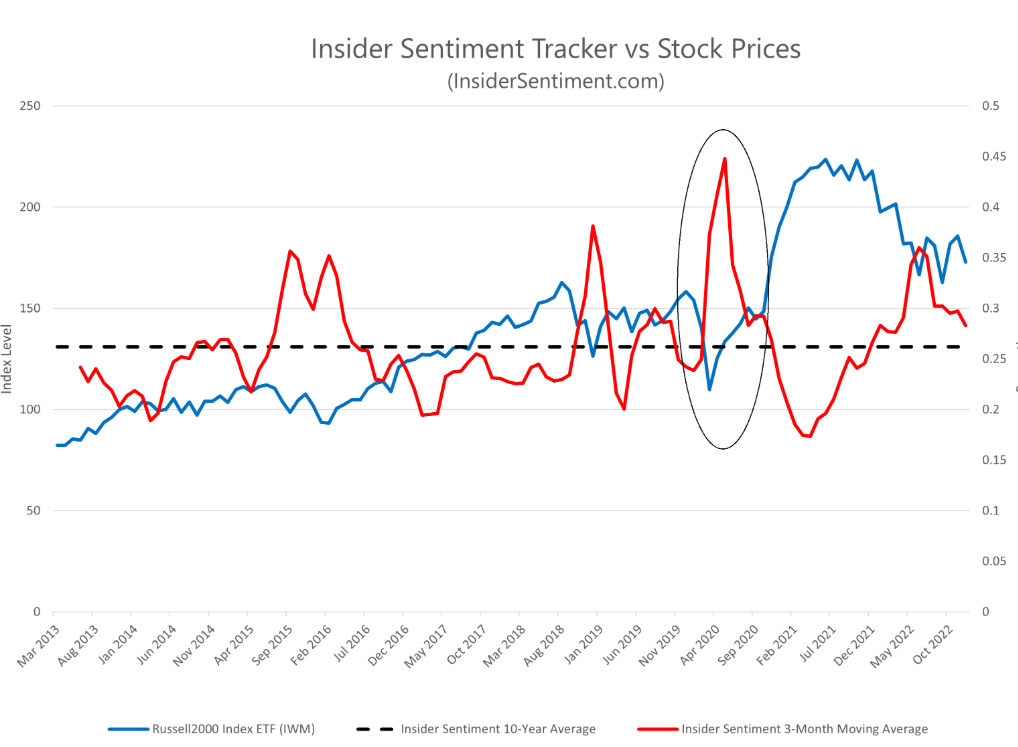
The chart above, from the Insider Sentiment website, shows that when the stock market crashed in March 2020 (see the blue line), insiders started buying their own firm’s stock in record numbers (see the red line), signaling a market rebound. Later, insider selling preceded the 2022 bear market.
Selling is not a confession.
Let’s add some disclosures here: Corporate insiders cannot predict the future, and neither can investment professionals, economists, or columnists (myself being each of the last three). Insiders might act too soon or make mistakes. Also, selling stock does not always mean they expect the company to face problems.
An executive may sell to pay taxes, buy a house, fund a divorce settlement, diversify a concentrated fortune, or carry out a trading plan established months earlier. Some sales happen automatically under Rule 10b5-1 plans. A sale can have a dozen motives. That is why I do not pay much attention to a single executive selling one stock. What matters is the bigger picture.
Still, as a district attorney friend of mine once said, “There are things you know, and there are things you can prove.” I feel like the corporate insiders know something today, even if I can’t prove it. When so many insiders are selling across hundreds of companies, individual reasons matter less and the overall message is harder to ignore.
Seyhun’s research also shows that insider selling is more worrying when stock prices are already dropping. In those cases, insiders are not just cashing out after a rally. They might be signaling that they do not expect a quick recovery. In July, this uptick of insider selling happened as the semiconductor sector, a key market leader, entered bear-market territory.
However, a counterpoint is the longer time frame. Insider sentiment has stayed below its long-term average for much of the past three years, even as the market rose. This shows that insiders can be early with their warnings. It may only be smoke, not fire, but, often, when there’s smoke…
Look at where insiders are buying.
The small areas where insiders are buying do not make the overall picture any more reassuring. Only consumer staples, materials, and utilities showed net insider buying. Investors usually turn to consumer staples and utilities when they feel less confident about economic growth and the market.
Again, this does not mean a decline is certain. But it does suggest that those who know their companies best are not eager to invest in many sectors of the market.
Because of insider selling, I am less comfortable with stocks that need everything to go perfectly to justify their prices (in the industry, we call that “priced to perfection”). I am also less likely to ignore weak balance sheets, risky business models, or valuations based mainly on overly aggressive profit estimates.
But it is not my job to focus only on the negative side, even when the warning signs are strong—otherwise I’d never be invested. Another data point—Dow Theory—is telling a more positive story.
Dow Theory says the bull market is still alive.
Dow Theory has been around for over 100 years, and its main idea remains helpful. Industrial companies produce goods, and transportation companies deliver them. When stocks in both groups hit new highs, it usually means economic growth is widespread, not just limited to a few companies with popular stocks.
The artificial-intelligence boom is part of the reason for this strength. AI is not just about semiconductor designers and cloud companies. Data centers need steel, concrete, electrical equipment, transformers, cooling systems, and lots of construction materials. Railroads and other transport companies move much of this material.
Consensus estimates for 2026 rail-transportation revenue growth increased to 6.6 percent, more than double the 2.9 percent estimate from March, and forward rail earnings hit record highs, according to Benzinga. The AI investment boom is now reaching beyond tech companies and into the real economy. That is a bullish sign.
There are some caveats (aren’t there always?). Transportation stocks were recently valued at about 24 times forward earnings, which is a record, and higher oil prices could squeeze margins. A bullish economic signal can turn into a less attractive investment when everyone has already paid up for it.
Still, Dow Theory should be taken seriously as a counterweight to insider selling. Insiders are warning that current high prices and prospects might not match up. The corroborating market averages say the economic expansion and bull trend are still broad. I will keep an eye on both for you. For now, the insiders have caught my attention, but they have not earned the right to overrule every other indicator.
The new Federal Reserve
The new Federal Reserve, led by Chairman Kevin Warsh, adds another layer of risk to the stock market.
Second-quarter gross domestic product (GDP) grew at an annualized rate of 1.5 percent, down from 2.1 percent in the first quarter. That headline looks weak, but the details were better. Final sales to private domestic purchasers—a measure that removes volatile trade, inventory, and government components—grew 3.9 percent, its best pace since the third quarter of 2023. Strong imports of AI-related equipment and an inventory drawdown depressed the headline GDP figure, even though much of that imported equipment should increase productive capacity later.
However, even though growth was better than the GDP number, inflation remains a problem for the Fed. The headline personal consumption expenditures price index (PCE) rose 3.7 percent from a year earlier in June 2026, down from 4.1 percent in May. While that is an improvement, it remains far above the Fed’s two percent target. Inflation has now been above the Fed’s target for 63 months: five long years of affordability pressure on consumers and businesses.
At its July 2026 meeting, the Federal Open Market Committee kept the federal-funds target at 3.5 to 3.75 percent, but the vote was nine to three. The three dissenters wanted a quarter-point increase. Warsh stressed that two percent is not just a goal; it is the target. He described the committee’s approach as “watchful thinking,” not just waiting, and said policymakers are more likely to tighten when the labor market is balanced and inflation is rising. I would argue that is the situation currently, meaning the Fed is setting us up for a rate hike.
The more important question is what happens after the first hike.
I reviewed the modern hiking episodes beginning in 1994, when the Fed started announcing policy changes in real time. I count six instances in which a new hike came after at least six meetings without an increase. Only twice did the Fed go six more meetings without raising again: March 1997 and December 2015.
But December 2015 was not a true one-off. The Fed waited a year, then resumed tightening, eventually delivering nine hikes through 2018. March 1997 was the only genuine one-and-done increase in the modern era.
The other five campaigns contained seven, six, 17, nine, and 11 hikes. The average was 10 hikes. Here is how the S&P 500 performed after those initial hikes, as well as after the last hike.
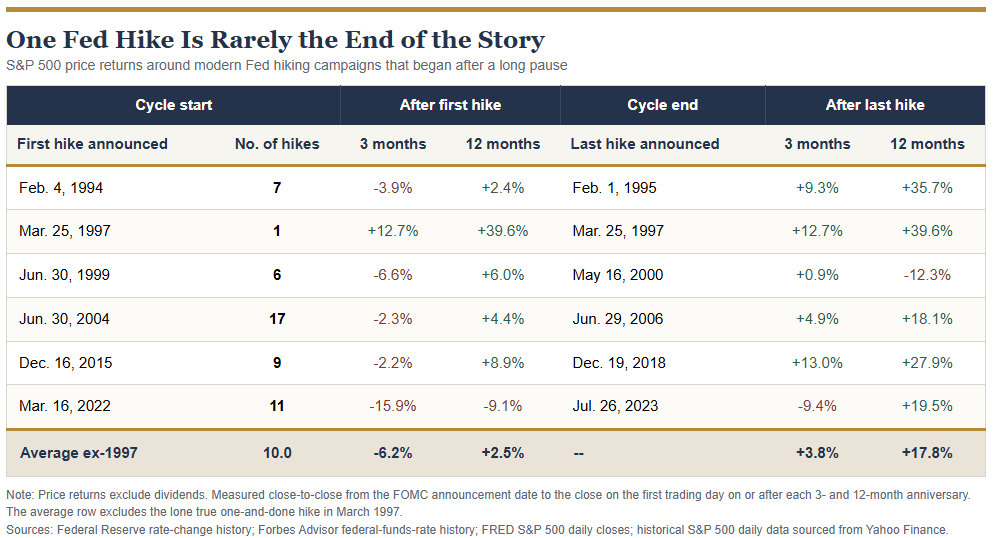
That doesn’t mean an interest rate hike in 2026 would be followed by nine more. Different economies lead to different policies. But investors should not assume that one hike will settle things. A new round of rate hikes would raise the discount rate for future earnings, put pressure on expensive long-term stocks, increase refinancing costs, and keep bond-market volatility high.
Historically, the first increase after a long pause is usually just the first step, not the whole climb. Historically, that has kept stock market returns negative (after three months from the first hike) and well below the average 12-month gains.
A new rate hiking campaign by the Fed would not automatically end the bull market. But higher rates would shrink the market’s margin for error. Remember what I said earlier about the risk of stocks being priced to perfection? Being stuck in an interest-rate-hiking campaign is far from perfect.
I am not calling the top. I am saying the market is offering enough warning signs that complacency is no longer an investment strategy. Because of that, at least in part, I recently sold out of my Invesco AI and Next Gen Software ETF (symbol: IGPT) and swapped proceeds into a small-cap fund, the iShares Russell 2000 Value ETF (symbol: IWN).
Allen Harris is an owner of Berkshire Money Management in Great Barrington and Dalton, managing more than $1 billion of investments. Unless specifically identified as original research or data gathering, some or all of the data cited is attributable to third-party sources. Unless stated otherwise, any mention of specific securities or investments is for illustrative purposes only. Advisor’s clients may or may not hold the securities discussed in their portfolios. Advisor makes no representation that any of the securities discussed have been or will be profitable. Full disclosures here. Direct inquiries to Allen at [email protected].


