His $1.4 Million Portfolio Is 70% Tech After a Decade of Gains, and at 66 He Won’t Let His Adviser Sell a Share. Waiting Until 70 Gives Him a $3,968 Monthly Social Security Benefit a Stock-Market Crash Cannot Cut
Quick Read
-
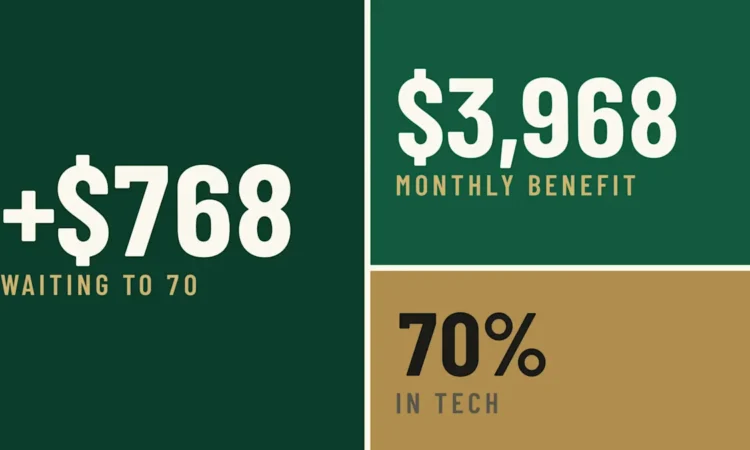
Delaying Social Security from 67 to 70 lifts a $3,200 monthly benefit to about $3,968, an income stream that stock-market crashes cannot touch.
-
Setting aside four years of spending in cash, Treasuries, or short-term bonds funds the wait and prevents forced sales of tech shares at market bottoms.
-
Trimming tech gradually before claiming benefits at 70 can cut capital gains taxes, hold down Medicare premiums, and limit taxes on Social Security.
-
Read: Building a portfolio and living off one are two completely different skills, and almost nobody teaches the second. This problem is what The Definitive Guide to Retirement Income helps with, and it is free today. Read more here.
Picture a 66-year-old with $1.4 million invested, 70% of it in tech after a decade of gains. That works out to $980,000 in one sector. His adviser wants to cut back. He refuses, because those shares built his wealth and selling feels like benching the players who won the title.

Plenty of retirees feel the same loyalty to the stocks that made them money.
Social Security plays a central role here because nothing else in his plan is so completely cut off from the stock market.
Waiting Until 70 Adds $768 a Month for Life
Assume his benefit at a full retirement age (FRA) of 67 is $3,200 a month. Every year he waits past that point makes the check 8% larger.
If he claims at 70, he collects $3,968 a month, or $47,616 a year before any future inflation adjustments.
Compared with claiming at 67, that’s $768 more each month, or $9,216 a year, for as long as he lives. Inflation raises are applied to the bigger base, and the 2027 increase is 3.6%.
Now consider a crash. If his tech holdings alone fell 40%, he would lose $392,000. His monthly benefit from the government would stay exactly where it was. The program’s risk is political.
——
Now Available: The Definitive Guide to Retirement Income
Many successful investors eventually reach the same moment. The saving is done, the portfolio is built, and the question quietly changes from how much can I grow this to how much can I take out? Get that second question wrong and decades of good investing can come apart in a handful of years.
That is exactly what The Definitive Guide to Retirement Income helps answer. It covers what your retirement could actually cost, which income sources are worth using, and the withdrawal math that decides whether the money lasts. It is free today from Fisher Investments. Read More Here ›
——
According to the trustees’ most recent report, the combined trust funds can pay 83% of scheduled benefits after 2034 unless Congress acts. That decision is up to lawmakers. Stock prices have nothing to do with it.