
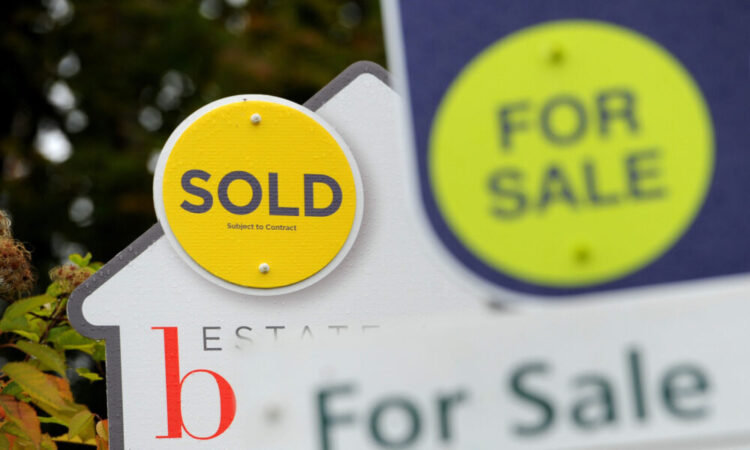
House prices softened in May, with the first monthly dip in property values recorded so far this year, according to an index.
The average UK house price dipped by 0.6% month-on-month in May – the first month-on-month fall since a 0.3% decrease in December 2025 – Nationwide Building Society said.
Annual house price growth slowed to 1.7% in May, from 3.0% in April.
Across the UK, the average house price in May was £278,024.
Robert Gardner, Nationwide’s chief economist, said: “Prices fell by 0.6% month-on-month, after taking account of seasonal effects – the first monthly decline so far this year.
“Given the uncertainty caused by developments in the Middle East and the subsequent rise in energy prices and market interest rates, some loss of momentum was to be expected.”
Mr Gardner said there has been some positive economic news, but added: “Nevertheless, economic growth is likely to be somewhat weaker and inflation higher than previously expected this year as a result of developments in the Middle East, although the impact will ultimately depend on the duration of the shock and the policy response.
“The UK economy and housing market have proved remarkably resilient in recent years.
“Household finances are solid, with total household debt at its lowest level relative to income for around two decades, and sizeable savings buffers have been built up, though these are not evenly distributed across households.
“Moreover, housing affordability had been improving steadily in recent years due to a combination of income growth outpacing house price growth by a wide margin and a modest decline in borrowing costs.
“While market interest rates have risen in recent months, the impact on affordability has so far been modest.
“Indeed, swap rates, which underpin fixed‑rate mortgage pricing, remain well below the highs reached in 2023 and are broadly in line with levels prevailing in 2024, implying only a partial reversal of earlier gains.
“This provides some confidence that, if the latest shock passes relatively quickly, and energy prices normalise in the quarters ahead, any near-term softening in the housing market will also prove short-lived.”
Jason Tebb, president of OnTheMarket, said: “The fallout from the war in the Middle East is making itself felt, with uncertainty and the challenging economic backdrop resulting in a softening in the market and some loss of momentum.
“That said, the housing market continues to demonstrate resilience. Average prices dipped on a monthly basis as focused, price-sensitive buyers negotiate hard, while sellers realise that they will struggle to sell over-ambitiously priced homes.
“This is the strongest ‘buyers’ market’ we have seen in many years, with plenty of stock to choose from.”
Tom Bill, head of UK residential research at Knight Frank, said: “This is further evidence that the housing market slowed down at precisely the time of year when you would expect momentum to be building.
“There won’t be a cliff-edge moment, but the impact of higher borrowing costs will erode spending power and squeeze house prices this year as mortgage rates agreed before the Middle East conflict gradually disappear.”
Ian Futcher, a financial planner at wealth manager Quilter said: “Mortgage rates will continue to dictate the pace of the market in the months ahead.
“Swap rates are heavily influenced by global developments, and without a clear resolution to current tensions there is a risk they could edge higher again.
“For those looking to buy or remortgage, rates are no longer rising sharply, but nor is there a clear path downwards.
“In this environment, reviewing options early and keeping flexibility, ideally with the support of a mortgage adviser, will put borrowers in a stronger position as the market continues to adjust.”
Martin Beck, chief economist at WPI Strategy, said: “Even if mortgage rates edge lower, the market remains vulnerable.
“Affordability is still stretched, mortgage repayments absorb a historically large share of household incomes, and a weakening labour market would pose a much greater threat to house prices than interest rates alone.”


