

The profile of investment in the UK has undergone a significant shift in the decade since the Brexit referendum, according to legal tech provider Search Acumen. By analysing historical inward foreign direct investment (FDI) datasets from the Office for National Statistics, the firm assessed annual European investment flows into the UK between 2006 and 2025.
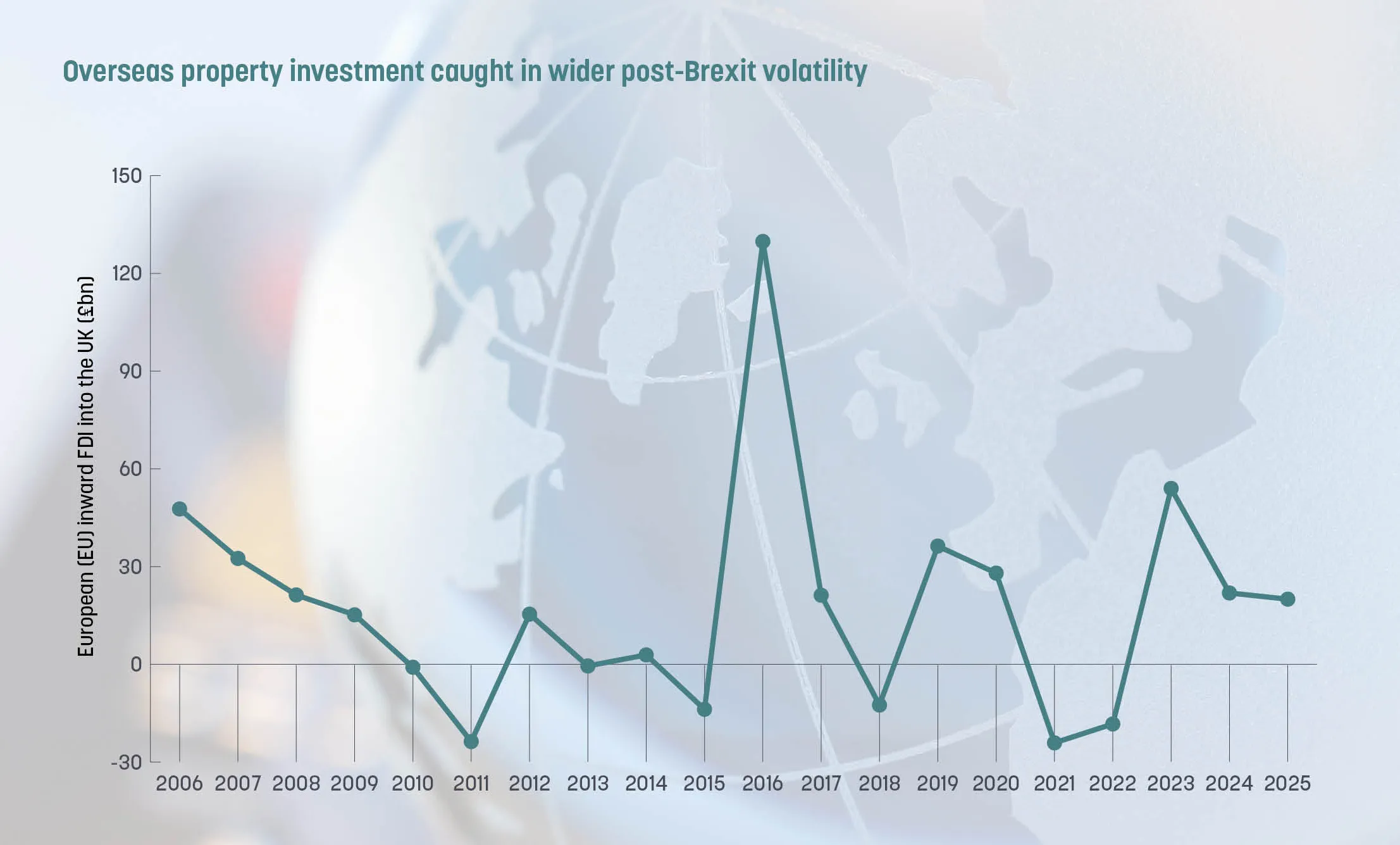
The findings show European investment in the UK has become more volatile, with changes affecting overseas property ownership coinciding with a decline in international investment during 2022.
Since August 2022, the Register of Overseas Entities has required overseas entities owning UK property to declare their beneficial owners, increasing transparency around non-UK ownership of property assets.
Search Acumen managing director Andrew Lloyd says the new taxes and rules played a critical role in the decline in overall international investment in 2022.
The UK has [become] a much more volatile investment destination
Andrew Lloyd, Search Acumen
“In 20 years, the UK has moved from being a production hub for European firms to a financially interconnected but much more volatile investment destination today,” he says.
The research examined annual FDI from EU member states, calculated as new investment entering the UK minus disinvestment. Negative values indicate a net withdrawal of investment, suggesting firms are reducing their exposure or restructuring existing operations, while positive inflows include mergers and acquisitions, intra-company loans and reinvested earnings.
According to Lloyd, while Brexit did not eliminate EU investment, it coincided with greater volatility, more reliance on financial flows and less consistent long-term industrial investment.
The findings have important implications for the property sector, where overseas capital has historically played a significant role in funding commercial real estate acquisitions, residential development and regeneration schemes.
The data suggests the nature of foreign investment has evolved, with more emphasis on financial transactions and corporate structures than on long-term operational expansion.


