
Canada’s carbon pricing wipes out Alberta oilsands’ edge in attracting investment dollars for new pipeline: Study
Canada’s industrial carbon tax pushes the cost of producing a marginal barrel of oilsands crude to $75 USD (at $95/tonne carbon tax)—well above what new projects in Texas or New Mexico face—stripping away the tax advantage Alberta needs to attract energy investment, according to a new Fraser Institute study by Jack Mintz, president’s fellow at the University of Calgary’s School of Public Policy.
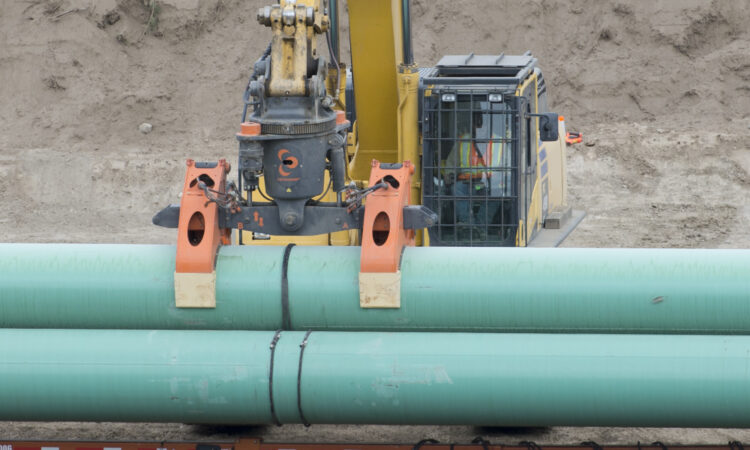
The findings land as Ottawa and Alberta advance a one-million-barrel-per-day West Coast oil pipeline proposal under their November 2025 memorandum of understanding (MOU) and May 2026 implementation agreement. So far, Pembina Pipeline Corp. is the only private partner to sign on, taking a 10 percent stake during construction, and no oil producers have yet committed to shipping on the line.
Mintz said the research began long before the current political moment.
“This work was started about three, four years ago—it was more of an academic interest,” he said in a phone interview with The Hub. “It struck me that no one had really looked at carbon taxation and how it affects competitiveness.”
A tax advantage erased
The study compares the marginal effective tax rate on costs (METC)—the share taxes add to the cost of the last unit produced—for oil, natural gas, and electricity in Alberta, Texas, and New Mexico. Marginal cost, Mintz argues, is what drives investor decisions on where to build.
Without carbon policies, Alberta wins on most fronts. Taxes, royalties, and fuel levies add 14 percent to oilsands costs, below the 14.6 to 15.7 percent in New Mexico and Texas respectively. Only conventional oil, saddled with a 33.9 percent revenue-based royalty, is taxed more heavily in Alberta.
Carbon pricing reverses the picture. At the $95-per-tonne carbon tax in 2025, the maximum METC on oilsands hits 48.8 percent—roughly triple the U.S. states—and climbs to 76.4 percent under the $170-per-tonne price originally planned for 2030. The projections calculated in the research were before the adjusted carbon pricing set by the Carney government, however Mintz did create separate calculations for the new scenario as well.

“Alberta would lose its tax advantages it had, both for oilsands and power in particular, as well as conventional crude,” Mintz said. “The story is that carbon taxation does put Canada [at a] tax disadvantage.”
In dollar terms, the oilsands supply cost of $51 USD per barrel without taxes rises to $58 USD with corporate taxes and royalties, and to $75 USD under the full $95-per-tonne carbon tax—unprofitable against a Western Canadian Select (WSC) price near $70 CAD.

The electricity blind spot
While public debate fixates on the oilsands, Mintz’s numbers suggest the biggest hit lands on electric power. Alberta’s maximum METC on power reaches 137 percent by 2030 under the original carbon price track—up to 12 times the 12 percent in Texas—while even the more lenient TIER-based rate reaches 47 percent.

“Electricity feeds right through the whole economy in terms of pricing and affects consumers, affects other businesses,” Mintz said. “That’s going to have a relatively damaging effect on the Alberta economy.”
CCUS: subsidized, but “no carrot”
Carbon capture, utilization, and storage (CCUS) narrows the gap on paper. With CCUS, U.S. power taxes actually turn negative by 2030 at minus 6.4 percent, thanks to the Inflation Reduction Act production credits, while Alberta’s maximum METC still sits at 85 percent.

Canadian CCUS incentives—a combined federal-provincial investment tax credit of roughly 62 percent plus carbon tax savings—are generous. But companies still bear the residual cost, which more than offsets the tax gains at the margin.
“As long as the companies have to pay something towards the cost of CCUS, it’s going to be a loser to them—extra cost on top,” he said. “If you’re looking from the company’s point of view, you ask the question: what is the net present value of carbon capture, utilization, storage? Leaving aside the political aspects, the net cost is negative to the company.”
Asked whether CCUS amounts to the “carrot” in Canada’s carrot-and-stick approach, he was blunt: “It’s not really a carrot.”
The MOU math
The core modelling predates the MOU struck by Prime Minister Mark Carney and Premier Danielle Smith, so Mintz added a section adjusting for the May 2026 implementation agreement: the carbon price now rises to $140 CAD per tonne by 2040 instead of $170 by 2030, with a minimum credit price climbing from $60 in 2030 to $110 by 2040, alongside tighter allowances.
By his calculations, the deal delays rather than removes the burden. In 2025 dollars, the carbon-policy changes add $3 USD per barrel to oilsands marginal costs by 2040, equivalent to $3.8 billion USD annually at 2025 production levels. They also add $3 USD per barrel for conventional oil, or $360 million USD annually. Under the report’s TIER-based $140-per-tonne (CAD) scenario, wholesale electricity rises from $41 to $53 per MWh.
“With respect to tax competitiveness, Alberta had a tax advantage, [and] that tax advantage will be effectively gone under carbon pricing, especially as we get closer to 2040,” Mintz explained.
Will anyone commit to a new pipeline?
That math shadows the pipeline push. With only Pembina at the table and financial details unsettled, Mintz said producers hold leverage, “The companies can really play hardball and say, ‘Look, you’ve got to do a bunch of stuff for us if we want to invest at all,’” Mintz told The Hub.
“The big issue is, will there be incentive for companies to build more [oilsands] plants in order to fill up the pipe? It’s one thing to build a pipeline. The question is whether you have enough oil to sell.”
Investors, he added, weigh opportunity cost: “A company is going to be looking at investment. Do I invest in Alberta… or would it be better to invest in Guyana or in some other country where I don’t have to go through all this?”

Graeme Gordon is The Hub’s Senior Editor and Podcast Producer. He has worked as a journalist contributing to a variety of publications, including CBC,…
A Fraser Institute study reveals that Canada’s carbon pricing has diminished Alberta’s competitive edge in attracting investment for oilsands projects. The carbon tax raises production costs significantly, making Alberta less attractive compared to Texas and New Mexico. As Ottawa and Alberta push for a new West Coast oil pipeline, concerns arise about the lack of commitments from oil producers. The study highlights that carbon pricing disproportionately affects electricity costs and questions the viability of new investments in Alberta’s oilsands amidst rising costs and competitive pressures from other regions.


