
Canadian guidebook for green and transitional investments will target six industrial sectors
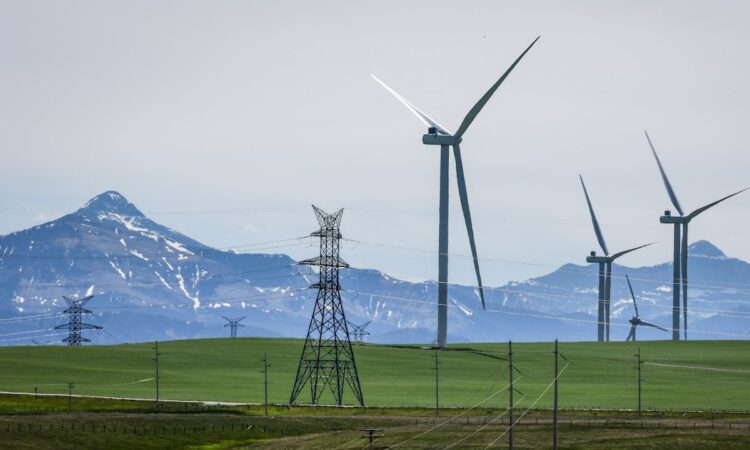
Power transmission lines and wind turbines near Pincher Creek, Alta. The Canadian guidebook will spell out eligible investments in electricity, buildings, transportation, mining, manufacturing and forestry.Jeff McIntosh/The Canadian Press
Developers of a made-in-Canada guidebook certifying green and transitional investments have chosen six industrial sectors to zero in on over the next 18 months, concentrating on climate action within them.
The new taxonomy, aimed at attracting more than $115-billion a year for meeting the country’s net-zero targets, will spell out eligible investments in electricity, buildings, transportation, mining, manufacturing and forestry, the council in charge of the effort said Tuesday.
According to the Canadian Taxonomy and Transition Planning Council, three are scheduled to be ready by the end of this year and the remainder in 2027. The document is being designed to ensure domestic and foreign capital is invested in projects that meet specific climate objectives and are not at risk of greenwashing. At least 60 other jurisdictions around the world have adopted similar taxonomies, or are in the process of doing so.
“The choice of the six sectors is a balancing act of wanting to tackle sectors where there are substantial emissions and where we can have a strong impact early on, and at the same time addressing those sectors where there are strong taxonomies in other jurisdictions that we can draw on,” council chair Marlene Puffer said in an interview.
Interoperability – the ease with which features of the taxonomy can be compared with those in other countries – is a key tenet of the process, Ms. Puffer said.
The document is also being developed to be credible and usable for investors, specific to Canada’s economy and geography, as well as dynamic – that is, adaptable to scientific and technological change, the council said in a statement.
It will set out sector-specific criteria for determining which investments are certified as green, such as renewable energy, and those that fit into a transitionary category. The latter would include technology for decarbonizing high-emitting industrial processes.
The council is planning a month-long consultation blitz starting July 9, during which it will seek feedback on a draft of its Canadian Sustainable Finance Taxonomy Methods and Frameworks Report. The report will guide its decisions about which activities will be called “taxonomy aligned.”
Development of a Canadian taxonomy has encountered several starts and stops over the years, but gained renewed momentum with the April appointment of several prominent sustainability professionals to the council, led by Ms. Puffer. In addition, nearly 60 experts from the institutional investment, academic, regulatory and non-governmental organization fields are part of financial services and technical advisory groups.
An investor-led organization known as Business Future Pathways is overseeing the effort, while the Canadian Climate Institute is in charge of research and technical aspects.
The council said it will concentrate initially on activities that deal with reducing impact on climate, which it says reflects the urgency of cutting global emissions while also aligning with other jurisdictions.
Once the initial phase is completed, the taxonomy can be expanded to include bolstering climate resilience, protecting water and marine resources, controlling pollution, guarding biodiversity and building a circular economy, it said.
During the consultation, business, non-governmental organization, scientific and civil-society representatives will be asked to comment on screening criteria, categories of investments, as well as planned measures that seek to “do no significant harm” and ensure “minimum social safeguards.”
Those include protecting Indigenous rights, general human rights, and environmental and social values. The council is looking to incorporate the work of Canada’s Truth and Reconciliation Commission and the United Nations Declaration on the Rights of Indigenous Peoples into its taxonomy, Ms. Puffer said.
“We’re especially making an effort in regard to depth and breadth of connection with Indigenous partners,” she said.
The taxonomy is being developed while Ottawa is smoothing the way for tens of billions of dollars worth of major energy, mining and infrastructure developments, many of which are being referred to its Major Projects Office for fast-track approval decisions.
Ms. Puffer said the MPO could be among organizations looking to make use of the taxonomy as projects seek investors. “I would expect that, where relevant, that they would aim to have some of their activities classified as aligned with the taxonomy and aligned with net zero.”


