
Buildings and their environments are frontline determinants of a long and healthy life. Heart, vascular and chronic lung diseases, cancers and diabetes – all known as non-communicable diseases (NCDs) – are long-term health conditions now responsible for about three-quarters of global deaths, and at least 80% of UK deaths. But they are not caused by infection. They are driven by the environment, modern lifestyles and deprivation.
The real estate investment industry is uniquely positioned to have a positive impact on public health and reduce huge costs to the NHS and economy, and our research shows it wants to help. However, interviews found that there has been no way for it to quantify the health cost savings value it can bring to urban investment projects. Without a way to monetise the health impact of development on local communities, there is little to no evidence to inform responsible risk assessment and fiduciary reporting.
Our research in the TRUUD (Tackling Root Causes Upstream of Unhealthy Urban Development) project aimed to change this, by equipping real estate investment asset managers with the tools needed to understand the impact of their projects on local communities and the mitigation of NCDs.
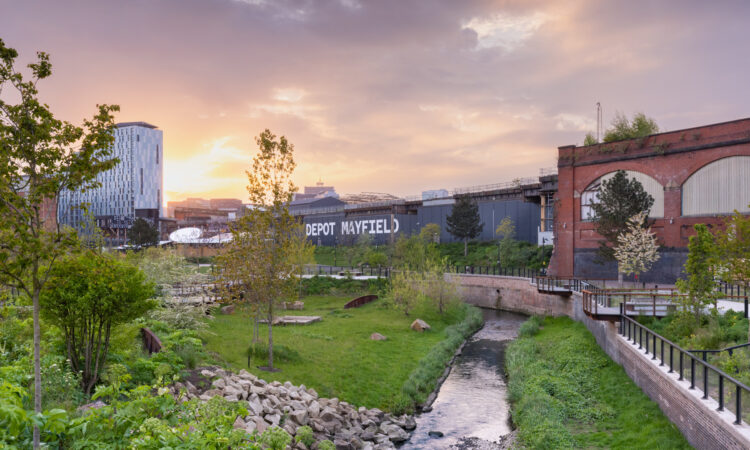
As part of the research, three UK real estate urban regeneration projects have been studied in collaboration with their asset managers. The latest report, produced in conjunction with Landsec focuses on its Mayfield Park regeneration project in Manchester. It identifies that £274m in health economic savings could be achieved for direct and wider communities over 25 years, from changes in the site set out in the Mayfield 2018 Strategic Regeneration Framework. This exceeds the local plan minimum value expected by around 5.9 times.
The first new park in Manchester for a century, the impact of Mayfield in part is due to additional flood mitigation measures and the large population living on site. 8,000 residents living within 300m of the development had a higher-than-average risk of chronic long-term disease reflecting the uneven nature of spatial health risk.
The Mayfield Park project reflects a joint venture between Manchester City Council, Transport for Greater Manchester, Platform 4 and Landsec, including a £23m grant from the government’s Getting Building Fund. The project illustrates how public private sector collaboration can assist in the successful pursuit of ambitious urban regeneration sustainability objectives.
Developed by academics at the University of Bath through the TRUUD programme, the Health Appraisal of Urban Systems (HAUS) model was applied to Landsec’s Mayfield regeneration to quantify its potential health economic savings. By assessing how site conditions and design choices influence outcomes such as physical activity, air quality and disease risk, the model gives investors and planners a practical tool to test options and strengthen the long‑term health performance of their schemes.
Its adoption into Ministry of Housing, Communities and Local Government (MHCLG) appraisal guidance earlier this year marks a move towards more consistent consideration of health in development decisions. With access to this data, urban decision makers can more confidently factor health outcomes into investment and design, helping to reduce non‑communicable disease risks for the communities that live in and interact with regenerated urban areas.
Moving forward, health cost savings evidence – such as the information gathered at Mayfield – can be incorporated in real estate decision making to inform financial risk modelling and ensure robust scrutiny of expected risk-adjusted returns to investors.
By quantifying social and health impact of urban developments, the industry can begin to put public and investor interests on the same footing, creating urban spaces that enable everyone to enjoy longer, healthier lives.


