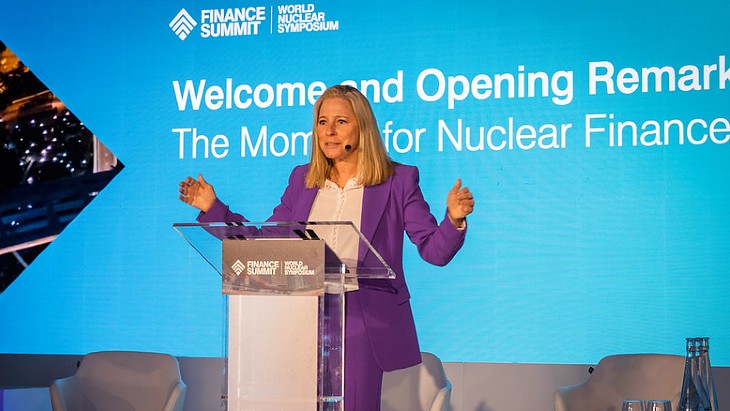
The growing interest in investing in nuclear energy, and how to ensure projects are structured to attract it, were key themes at the World Nuclear Symposium Finance Summit, which was also told that financiers feel like they are missing out if they haven’t done nuclear deals.
On the same day that Google announced a long-term power purchase agreement with Finland’s Fortum covering up to 50% of the Loviisa nuclear power plant’s capacity and providing financial certainty for power uprates and lifetime extensions until 2050, Lucia Tian, Director of Advanced Energy Technologies, outlined the scale of interest in the nuclear energy field at the moment.
“Just in the nuclear space, in the last year we’ve had discussions, or inbounds, from over a hundred different potential providers,” she said at the London event, before going on to say that for Google “it’s important it’s a credible project with real credible partners that we believe can deliver – we do our own deep diligence on that. Then we have to understand and believe in and find the economics attractive, and then last, but certainly not least, wherever that project is, there has to be community buy-in”.
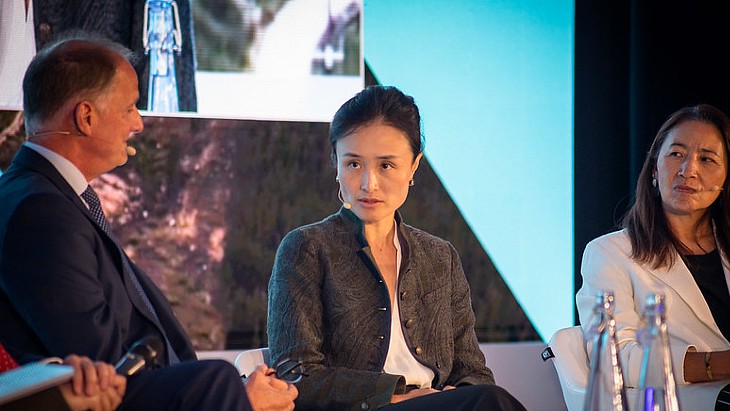
Google’s Lucia Tian, centre (Image: World Nuclear Association)
Tian was speaking at a panel focused on how end energy users are shaping nuclear development, which also featured Chad Eaton, Director of Government Affairs & Energy Policy at Nucor Corporation, who said they were in the process of “exploring a lot of those possibilities right now”.
The Finance Summit, organised by World Nuclear Association, is part of World Nuclear Symposium, which takes place in London on Thursday and Friday, with association Director General Sama Bilbao y León, saying the summit was “designed to convene the decision-makers and leaders from international finance, government, multilateral institutions and the nuclear sector, together to move the conversation from diagnosing the financing challenge to delivering solutions”.
She said that over recent years “the conversation for expanding nuclear moved from ‘if’ or ‘why’, to ‘how’ and ‘when'”. But, she said, “many external observers then pointed to the fact that financing the capital needed to build a new nuclear reactor can cost more than the capital itself to build that reactor … since that diagnosis, we have had many financial institutions knocking at the nuclear industry’s door, asking for meetings to help understand our sector. This development is what led to the start of our invitational Financing Nuclear Briefing Series, the first Finance Summit ahead of last years 50th World Nuclear Symposium and then the publication yesterday of our World Nuclear Investment Guide”.
“Now is the time to press on, to continue sharing knowledge, to devise and implement solutions. Achieving industrial scale worldwide, rather than in just a few existing markets, will require significant investment from private, as well as public sources of finance, with capital flowing not only to new generating capacity, to long-term operation but also to the nuclear fuel cycle needed to deliver it at scale. What I hear time and time again is ‘there is no shortage of capital’. It’s about finding the right frameworks, structuring, valuation, and risk allocations to allow capital to flow at scale”, she said, saying that goal was to help unlock the capital.
A variety of panels with high-level speakers covered a range of issues relating to financing nuclear, during the day, discussing both the appetite for private sector investment in nuclear, the way such projects can be structured, and risks allocated – especially for first of a kind projects as well as broader risk-reward factors – and the steps that governments can take to make projects more attractive. In the wake of the publication of the full World Nuclear Finance Guide on Tuesday, there was also agreement on the need for the nuclear and finance worlds to deepen their understanding of each other.
Mark Muldowney, Managing Director, Energy, Resources and Infrastructure, BNP Paribas, said: “Every year, over the past 15 years or so that I’ve been heavily involved in the nuclear sector, things have got steadily better in terms of the number of institutions who understand the sector, who have stopped saying ‘we don’t do nuclear’ … there are people now who are nervous that they haven’t done nuclear deals – there’s a feeling that they’re missing out on great opportunities out there that they should be taking advantage of … and that creates a sense of momentum.”
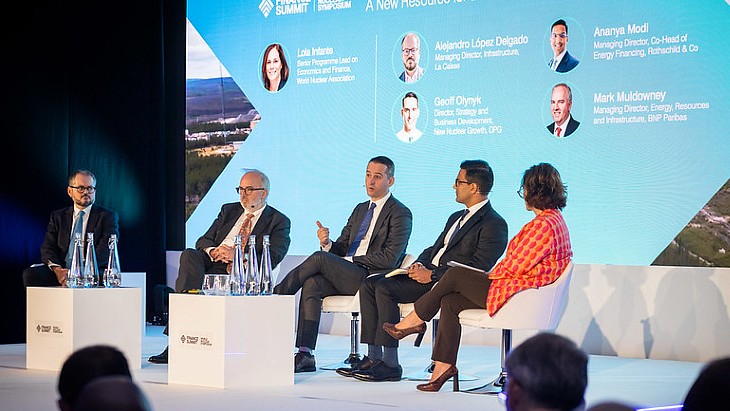
There was a wide selection of panellists at the event (Image: World Nuclear Association)
Grant Isaac, President and Chief Operating Officer, Cameco, said of the finance guide: “Rather than it being the responsibility of the global investment community to come across and learn everything that’s unique and special about our industry, the guide turned it round and said it’s the responsibility of our industry to figure out what good investible projects are, because, when we do, there’s a lot of capital out there that’s interested in our industry.”
Alejandro López Delgado, Managing Director, Infrastructure, La Caisse, who invested in nuclear for the first time, last year in the UK’s Sizewell C project, said: “Through that process we realised how limited information there is about nuclear for investors … and then once we did the investment we were approached by many governments, corporate developers with potential projects, and we also realised that sometimes the industry and the government don’t know us investors as well as you might expect … they don’t know our needs and what makes a project investible – there is clearly a gap to be bridged and the guide is is the perfect instrument to bridge that gap.”