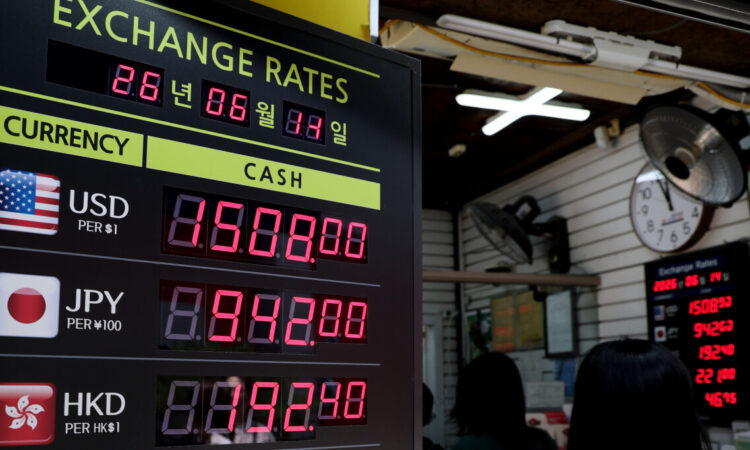
The Korean won has fallen nearly 6 percent against the dollar this year, pressured by massive foreign selling of domestic stocks and marking one of the weakest performances among major currencies.
Korean won has weakened by nearly 6 percent against the dollar this year, central bank data showed Sunday, as foreign investors sold off more than 156 trillion won ($102.3 billion) worth of domestic stocks.
The average exchange rate stood at 1,484.56 won against the dollar during the first half of the year, according to the Bank of Korea’s Economic Statistics System.
It marked the second-highest first-half average on record, behind 1,493.08 won in the first half of 1998 during the Asian financial crisis.
The won has traded in the 1,500 range against the dollar in March for the first time since the global financial crisis, following the outbreak of conflict in the Middle East.
Although the won briefly retreated to the low 1,400 range against the dollar, the won rebounded above the 1,500 range against the dollar in mid-May and has remained above this level ever since.
The broad weakness of the won this year has made it one of the worst-performing major currencies.
The won’s value had depreciated 5.92 percent against the dollar on Friday, compared to the end of last year, according to Yonhap Infomax, the financial arm of Yonhap News Agency.
Among the Group of 20 currencies, only the Turkish lira, which weakened by 8.23 percent, and the Indonesian rupiah, which weakened by 6.56 percent, posted larger declines.
A key factor behind the won’s weakness has been heavy foreign selling of Korean equities.
From the beginning of the year through Friday, foreign investors sold a net 156.56 trillion won worth of shares on the benchmark Kospi market.
That figure is more than five times larger than the 34.6 trillion won in net foreign selling recorded during all of 2008, the year of the global financial crisis.
Yonhap