The paper behind the dollar: Crane Currency celebrates 225 years of ‘heritage and innovation’ | Business
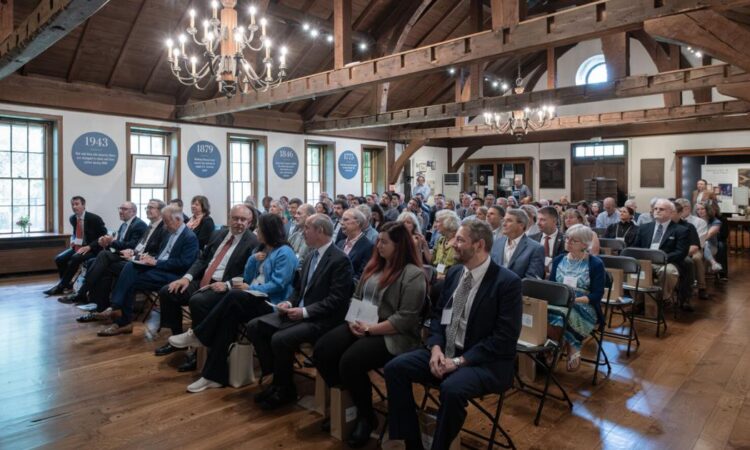
DALTON — While Crane & Co. was founded in 1801, U.S. Rep. Richard Neal noted on Tuesday, the family’s history dates back to the signing of the Declaration of Independence.
In 1775, Paul Revere produced printing plates for the first U.S. securities, serving as a precursor to the first U.S. paper money. The banknote paper was supplied by papermaker Stephen Crane.

Founded in 1801 by Zenas Crane, Crane’s currency division has supplied paper to the federal government since 1879, and has been its sole supplier since 1964.
Zenas Crane later founded Crane & Co. in 1801, which Neal pointed out was when Thomas Jefferson was president of the United States. For Dicken Crane, that connection to American history was moving.
“You don’t think about it every day,” said Crane, a sixth-generation member of the family. “It’s like, ‘Wow.’ That creates some perspective that you don’t have in your everyday life, and that was what struck me.”
Crane was one of over 50 people who attended Tuesday’s 225th anniversary celebration of Crane Currency at the Crane Museum of Papermaking. The by-invitation event featured Crane management past and present, Crane family members and several state representatives.
A reception and luncheon followed the program, which included the remarks by Neal and many others.
Founded in 1801 by Zenas Crane, the company’s currency division has supplied paper to the federal government since 1879 and has been its sole supplier since 1964. It also operates a plant in Sweden and Malta and produces currency paper for several other countries.
Crane Currency, a Crane NXT company, is a leading printer of secure, durable, and well-designed banknotes for central banks around the world.

History of the Crane company is depicted throughout the Crane Museum of Papermaking in Dalton in 2014. Founded in 1801 by Zenas Crane, Crane’s currency division has supplied currency paper to the federal government since 1879 and has been its sole supplier since 1964.
“I think what makes today so neat is not just the celebration … but the great pride everyone in this company takes in the mission that we do for this country and for others,” said Aaron Saak, chief executive officer of Crane NXT.
Around 1801, Zenas Crane employed a staff whose weekly wages ranged from $0.60 to $3.50, according to the museum.

A press used to print and engrave bank notes on Crane paper is shown at the Crane Museum of Papermaking in Dalton in 2014.
Now, with over 200 years of heritage, the company serves more than 50 central banks globally, offering a unique blend of expertise in design, papermaking and printing, according to its website.
Saak joked that when Zenas Crane started the company, the best way to deliver a message was by horse — and now it’s Instagram, “if you have teenage children.”
Michael Brown, acting director of the Bureau of Engraving & Printing, underscored that Crane Currency now supports more than 500 highly skilled jobs across Massachusetts, New Hampshire and Georgia. He also said that generations of employees have carried forward a tradition of excellence while adapting to changing technologies.
“That combination of heritage and innovation is indeed rare, and it is one of the reasons Crane has remained a leader for more than two centuries,” Brown said.
During the program, a short film was shown that featured employees talking about the culture of the company. One employee said that the “people are what make the job.”

Members of the Crane and Kittredge family gather outside the Crane Museum of Papermaking on Tuesday morning for the 225th anniversary celebration of Crane Currency.
Dicken Crane said that getting together with other family members “doesn’t happen as much as it used to.” He said that his father, grandfather and brother worked for the company, and added that he worked for one summer in the 1970s.
He now runs Holiday Brook Farm in Dalton, where his family has farmed for four generations.
Presenters at the event included Brown, Neal, Hugh Nathanial Halpern, director of the U.S. Government Publishing Office, and Brian Lawler, senior associate director of the Federal Reserve Board.

Crane Currency held a 225th anniversary celebration at the Crane Museum of Papermaking on Tuesday morning that featured numerous guest speakers. From left, Brian Lawler, senior associate director of the Federal Reserve Board; U.S. Rep. Richard Neal, D-Springfield; Hugh Nathanial Halpern, director of the U.S. Government Publishing Office; Michael Brown, acting director of the Bureau of Engraving & Printing; and Aaron Saak, CEO of Crane NXT.
During his speech, Neal said that our currency is one of the “great legacies and institutions in American history.” He also highlighted the work done at the company, its skilled employees and management and the “legacy of the Crane family.”
Brown spoke about the company’s longevity, noting there are not many companies on Earth that are 225 years old.
“There is craftsmanship, innovation and expertise that make trusted currency possible,” he said. For generations, he added, Crane Currency has been an “essential part of that story.”

Women in the rag room shred cotton and linen rags to be made into paper at the Crane Old Stone Mill. The mill was used from 1844 to 1870 when it was torn down, leaving the Crane Museum of Papermaking, the room that was once the rag room, as the last remanant of the building in Dalton.
With the rise in counterfeit currency, maintaining confidence in the U.S. dollar requires constant vigilance and the need to stay ahead of emerging threats, Brown said. He added that the partnership between Crane Currency and the Bureau of Engraving & Printing “matters so much.”
“We are helping safeguard one of the most recognized and trusted symbols of American stability, of America’s strength and of America’s leadership on Earth,” Brown said.

Crane Currency makes the substrate for U.S. currency, shown in this 2015 photo. The company held a 225th anniversary celebration at the Crane Museum of Papermaking on Tuesday morning.
Saak also said the company is significantly increasing its investments and recently completed upgrades for the new U.S. currency series in Dalton. He added that the company is expanding its footprint in other facilities around the world.
He also noted that the company is filled with multiple generations of families that have worked or currently work for the company.
And being relevant, he said, does not happen by accident.
“It requires a willingness to adapt, to invest and to challenge ourselves in this company to evolve,” Saak said. “That’s our job.”