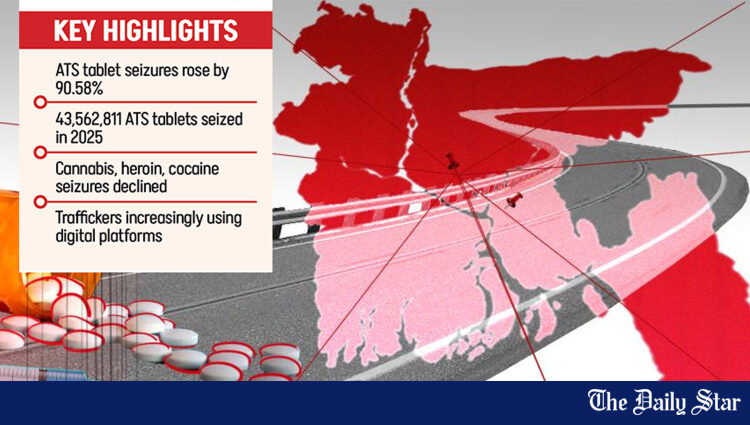
Seizures of yaba and other amphetamine-type stimulant tablets rose by 90.58 percent in 2025 compared with the previous year.
The picture emerged in the DNC’s Annual Drug Report Bangladesh 2025, which shows law enforcement agencies seized 43,562,811 ATS tablets in 2025, up from 22,857,751 in 2024.
ATS, or amphetamine-type stimulants, are synthetic stimulant drugs that include MDMA and methamphetamine-based yaba, officials said.
In 2023, the seizure stood at 42,977,219 tablets.
Meanwhile, cannabis seizures fell from 114,345.2kg in 2024 to 96,357.58kg in 2025. Heroin seizures dropped from 502.686kg to around 336.696kg. Phensedyl seizures fell from 5,72,865 bottles to 3,19,940 bottles, while buprenorphine seizures declined from 1,57,977 to 1,34,468 ampoules.
Cocaine seizures also dropped sharply, from 130.184kg in 2024 to 14.651kg in 2025.
Mohammad Badruddin, additional director (intelligence) at DNC headquarters, said the rise in seizures was linked to an increase in the supply of and demand for yaba.
Md Hasan Maruf, director general of DNC, said supply had increased as Myanmar rebel groups were using yaba as a “narco-currency”.
“With limited access to conduct operations inside Myanmar territory, we conduct drives whenever we receive information about smuggling,” he said.
Amid the situation, the government has taken steps to strengthen the DNC’s operational capacity.
Speaking at a discussion in Dhaka on Friday, Home Minister Salahuddin Ahmed said an amendment to the Narcotics Control Act would be placed in parliament within the next couple of days.
Under the proposed amendment, DNC officials would get modern weapons and updated training to fight armed drug dealers and smugglers using modern technology, he said.
Towhidul Haque, associate professor at Dhaka University’s Institute of Social Welfare and Research, however, said the drives and initiatives had failed to stop drug trafficking, trading and abuse mainly due to a lack of political will.
“Organised groups, from influential quarters to small dealers, are involved in the trade. Since the authorities know the routes, carriers, dealers and users, failure to control it raises serious questions,” he said.
The report said cannabis remained the most prevalent drug in the country, accounting for more than 50 to 60 percent of cases detected by the DNC in 2025.
The annual DNC report said Bangladesh’s location between major drug-producing regions, along with its borders with India and Myanmar, has made it vulnerable to trafficking.
It said yaba and crystal meth continue to enter the country mainly through the Bangladesh-Myanmar border, while traffickers are also using coastal, riverine and other alternative routes.
The report identified Cox’s Bazar, Chattogram, Cumilla, Brahmanbaria, Narshingdi, Faridpur, Gazipur, Narayanganj, Tangail, Mymensingh, Rajshahi, Natore, Naogaon, Pabna, Sirajganj, Bogura, Joypurhat, Dinajpur, Kurigram, Lalmonirhat, Rangpur, Satkhira, Jashore, Kushtia and Chuadanga as among the narcotics-prone districts.
It also listed several vulnerable trafficking points along the western, northern and southeastern borders. In the southeast, Teknaf, Cox’s Bazar, Shahporir Island, St Martin’s Island, Ukhiya and other coastal and border points remain critical.
The DNC report said traffickers were increasingly using social media, online marketplaces, encrypted messaging apps, courier services and digital payment systems.
According to the report, some traffickers swallow yaba tablets, hide drugs in shoes, walking sticks and vehicle tyres, and use women and children as carriers.
At the Friday’s event, the home minister said the government was following a zero-tolerance policy against drugs and working to implement its anti-drug strategy strictly.
He said changes were being made to the legal framework, on the advice of the National Telecommunication Monitoring Centre, to track money laundering through anonymous SIMs, mobile financial services, OTP and WhatsApp.
The minister said the government was not limiting its action to retailers or carriers, but was also committed to bringing the masterminds, financiers and godfathers of the drug trade to justice.