
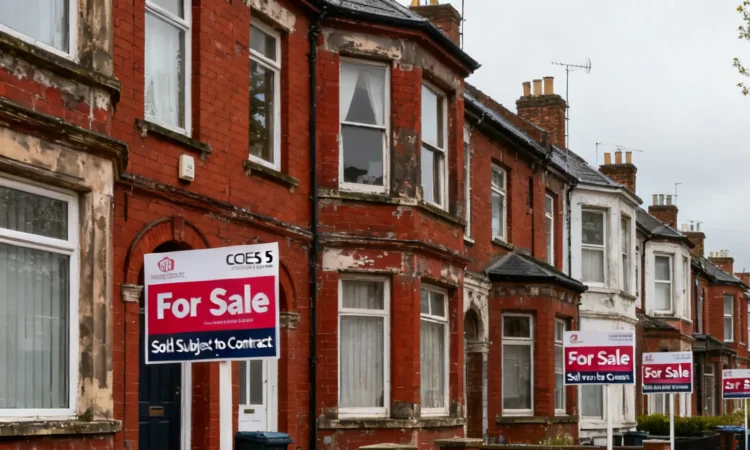
UK house prices declined 0.6% in May 2026, marking the first monthly fall of the year, according to data from Nationwide Building Society. The lender attributed the decline to uncertainty linked to the conflict in the Middle East, which has affected consumer confidence and housing market activity.
Annual house price growth slowed to 1.7%, down from 3.0% in April, with the average home now valued at £278,024. The figures represent a significant deceleration in a market that had shown signs of recovery earlier in the year.
Economic uncertainty weighs on market
Robert Gardner, Nationwide’s Chief Economist, said: “Given the uncertainty caused by developments in the Middle East and the subsequent rise in energy prices and market interest rates, some loss of momentum was to be expected.”
Consumer confidence has weakened since the start of the conflict, whilst housing market sentiment has also deteriorated. Data from the Royal Institution of Chartered Surveyors shows new buyer enquiries fell sharply in March and remained in negative territory in April.
Gardner noted that the UK economy entered this period on a stronger footing than expected, growing 0.6% quarter-on-quarter in the first three months of the year, whilst inflation softened more than expected in April. However, he warned that economic growth is likely to be weaker and inflation higher than previously expected this year, although much depends on the duration of the shock and policy response.
Market dynamics shift towards buyers
Industry professionals reported a market increasingly sensitive to pricing. Amy Reynolds, Head of Sales at Richmond estate agency Antony Roberts, said: “Buyers are not stretching to make offers they don’t believe will be accepted – they are simply choosing alternative properties. In certain price brackets, buyers have the luxury of choice, and vendors need to be mindful of this.”
Tom Bill, Head of UK Residential Research at Knight Frank, said: “This is further evidence that the housing market slowed down at precisely the time of year when you would expect momentum to be building. There won’t be a cliff-edge moment, but the impact of higher borrowing costs will erode spending power and squeeze house prices this year.”
The shift comes as major forecasters have adjusted their price growth expectations in response to changing economic conditions.
Supply and demand dynamics
Iain McKenzie, CEO of The Guild of Property Professionals, highlighted that rising supply levels, now at their highest point in more than a decade, are giving buyers greater choice and shifting negotiating power in their favour. Sales agreed are running ahead of last year for the first time in 2026, indicating that committed movers continue to transact despite broader uncertainties.
Nathan Emerson, CEO of Propertymark, said: “Stable house prices will be welcomed by many buyers and sellers looking for greater certainty in the market after a prolonged period of economic volatility. Buyers who need to move are continuing to act decisively, particularly where mortgage rates have stabilised.”
Mortgage market response
Mark Harris, Chief Executive of mortgage broker SPF Private Clients, said: “Falling monthly house prices suggest needs-based buyers are not willing to pay over-the-odds for a property but are negotiating hard. Lenders continue to cut their mortgage rates, and the steadiness from the Bank of England in holding base rate should lead to a period of calm.”
Jeremy Matallah, Co-Founder of rent-to-buy housing provider Keyz, noted that affordability remains the single biggest issue facing the housing market, particularly in London. “Although the capital has seen some of the weakest house price growth in the country, buying a first home still feels frustratingly out of reach unless there’s significant family support,” he said.
Market outlook
Despite the monthly decline, several industry figures emphasised the market’s underlying resilience. Marc von Grundherr, Director of Benham and Reeves, said: “A monthly dip in house prices shouldn’t be mistaken for a market downturn. Buyers remain active, transaction levels are holding firm and house prices remain higher than they were this time last year.”
Jason Tebb, President of OnTheMarket, described current conditions as “the strongest buyers’ market we have seen in many years, with plenty of stock to choose from.” He added that needs-based buyers are transacting, encouraged by lenders continuing to trim mortgage rates.
The data suggests the UK housing market is entering a period of adjustment, with price sensitivity increasing and negotiating power shifting towards buyers. Whether this represents a short-term correction or the start of a more prolonged slowdown will depend largely on how quickly economic uncertainties resolve and whether mortgage rates continue to stabilise.


