
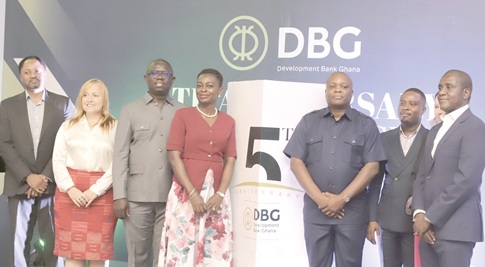
Long-term development lender, Development Bank Ghana (DBG), will shift from institution-building to “surgical, targeted scaling” over the next five years, with deeper investments in oil palm, textiles, pharmaceuticals, green finance and women-led businesses, the Chief Executive Officer (CEO) of the bank, Professor Randolph Nsor-Ambala, has said.
At the launch of DBG’s fifth anniversary in Accra yesterday, he said the bank had spent its first five years stabilising operations and proving the concept that long-term financing could transform Ghanaian businesses.
The next phase, he said, would focus on areas where evidence showed impact had been highest.
“What Ghanaians should expect from us in the next five years is essentially that we are going to scale up.
We are going to do more of what we do better, taking from the learnings of the past five years,” he stated.
The two-day celebration, scheduled for November 16 and 17, is to acknowledge DBG’s role as the nation’s wholesale development finance institution.
The DBG was established in 2021 to address the long-term financing gap for Micro, Small and Medium Enterprises (MSMEs), which make up over 80 per cent of businesses in the country, but have historically struggled to access affordable, long-tenor credit from commercial banks.
Focused, evidence-based
Prof. Nsor-Ambala outlined DBG’s strategic direction as more surgical, more targeted and more impactful.
“In agriculture and agribusiness, we have a priority focus on oil palm across the entire value chain, from cultivation to processing and export. On manufacturing, there is expanded financing for the textile sector to support local production and job creation.
“Also for pharmaceuticals, there is an increased investment to reduce import dependence and strengthen local drug manufacturing capacity,” he said.
The CEO of DBG added that, building on gains made in the last five years, significant scale-up of funding for climate-smart and environmentally sustainable enterprises and also more resources directed to enterprises owned and run by women would be made.
5-year scorecard
Reflecting on DBG’s first five years since its launch in 2021, the CEO said the bank had created and sustained over 100,000 jobs across partner MSMEs.
He indicated that the bank had also invested over GH¢1.5 billion in women-led businesses and disbursed a total of GH¢2.5 billion to nearly 1,000 businesses across agribusiness, manufacturing, ICT and high-value services, including hospitality, tourism, transportation, education and health.
While disbursing these funds, Prof. Nsoh-Ambala stated that DBG also achieved zero defaults on its portfolio to date and contributed remarkably to improving credit flow to the agriculture sector.
Partnership model
Responding to concerns that DBG’s impact has been limited to small-scale businesses and is not widely felt, the CEO of DBG acknowledged the scale of the country’s MSME financing gap but defended the bank’s partnership model.
“Inasmuch as we have evidence to suggest that we have been impactful, we also acknowledge that we are nowhere near fully resolving the persistent challenges the sector faces,” he said.
He explained that because DBG operated as a wholesale bank, many businesses accessing funds might not know they were using DBG capital.
“There will be a lot of businesses that have probably been doing business with DBG money and do not know.
Our impact is out there, but the scale of the problem requires us to continue going at this persistently and at scale. So, you may be doing business with DBG money, but you probably do not,” he said.


